|
| |
| |
| | |
|
Peak: The Moment Performance, Clarity, and Pressure Converge
|
| | | |
| | |
| Welcome to Our Latest Newsletter!
📚 Read Time: 8 Minutes
A peak isn’t a reward, it’s a convergence. It’s the point when preparation, timing, and focus align under pressure. Physically, it’s when the body performs at its highest output. Mentally, it’s when attention locks in and decision-making sharpens. Emotionally, it’s when you feel the weight and meaning of the moment. Peaks aren’t permanent, but they’re defining. They show you what your current best looks like under demand.
This edition breaks down what it means to reach a peak, how it happens across domains, and what comes after. We’ll look at the science behind peak performance and experience, the psychology of goal pursuit, and how to structure training that leads to a summit moment, whether that’s a race, a speech, a life milestone, or something personal you’ve built toward for years.
🔗 Want to revisit past editions or share with someone who could use this?
Check out the full Tiger Resilience archive and share to sign up for future newsletters here:
👉 Explore the Tiger Resilience Newsletter Library |
| | | |
| | |
| What Is a Peak?
A peak is the maximum expression of current capacity under pressure. It’s not just feeling good or hitting a milestone, it’s a measurable convergence of readiness, timing, and demand. Peaks expose your limit in real time, across different systems. They’re specific, not abstract. Here’s how that plays out:
Physical:
High output with low inefficiency. You’re hitting top ranges of power, endurance, or coordination with minimal waste. VO₂ max, lactate clearance, neuromuscular efficiency, HRV, all trending toward optimal. It’s not forever, it’s a window. Most people misread a good day as a peak. A real physical peak is planned and brief.
Cognitive:
High focus, low friction. Working memory is clean. Decision-making is fast and accurate. Distractions drop out. Often tied to transient hypofrontality and a well-timed neurochemical cocktail, dopamine, norepinephrine, anandamide. This is the zone, not luck.
Emotional:
Acute intensity with clarity. Not just feeling deeply, but being fully present in it. Joy, awe, love, even grief, when your emotional system is fully online and integrated. Psychologists call these “peak experiences” because they imprint. They change memory, behavior, and identity.
Spiritual:
Full system alignment. You’re not dissociating or escaping. you’re locked into something larger. Call it connection, call it clarity. Spiritual peaks aren’t fluffy. They’re often hard-won and come with cost. But they change direction more than any other type.
Peaks are snapshots of current max. They don’t last, but they reveal what’s possible. You can’t live in a peak, but you can train for one, learn from one, and build on what it shows you. |
| | | |
| | |
| Michael’s Perspective: The Peak You Earn, Not the Peak You Predict
People kept asking me if I felt different after getting married this past weekend. It’s a normal question, and the honest answer I kept giving was, I don’t know. Not out of hesitation, not out of confusion, and not because the moment didn’t matter. Quite the opposite. The experience was so significant and so grounded that it didn’t feel like a dramatic shift. It felt like arriving in a place I had been moving toward for a long time without fully realizing the altitude I had climbed to.
What I do know is this. Getting married didn’t make me someone new. It clarified who I already am and who I intend to be. That’s what genuine peak experiences do. They don’t inflate you or overwhelm you. They heighten your awareness to the point where you see your life with more precision. You see your values expressed in real time. You see the weight of your choices and the direction they’re pointing.
Maslow called this self-actualization, not as a permanent state, but as a moment where your behavior, your purpose, and your identity align. A peak experience isn’t a reward. It’s a reflection. It shows you that the work you’ve done internally has reached a point where something meaningful can actually exist in the external world. You feel the clarity, the connection, the intensity, but you also feel the responsibility that follows.
That’s why I don’t know felt accurate in the moment. It wasn’t uncertainty. It was the recognition that the shift isn’t emotional whiplash, it’s integration. It’s the awareness that something real has begun, and that the feeling of difference will unfold gradually as the commitment deepens in daily life.
But here is what I do know. Standing there with my closest people, marrying someone who feels like both home and forward motion, was a peak in every sense. Not in the “summit” sense. In the self-actualizing sense. In the sense that your internal and external worlds line up so cleanly that you feel fully present. No noise. No drift. Just clarity.
And I also know that this kind of peak isn’t something you lock in and walk away with. The moment isn’t the marriage. It is the indicator of what the marriage requires. If anything, the peak raises the standard. It tells you how deeply you’re capable of showing up. It reveals the level of communication, patience, alignment, and intention you need to sustain something that actually matters.
That’s where the concept of peaks becomes useful. A wedding is one kind of peak, but it isn’t the only one. There will be future peaks. The birth of a child someday. Major transitions. Moments that test my capacity to lead, support, and stay aligned. But those moments don’t happen in isolation. They’re the product of how I show up on the days that feel flat or ordinary. Every long-term relationship has thresholds you meet again and again. You can’t hit a peak once and assume it will carry you. You earn it repeatedly.
This weekend taught me that a peak isn’t a finale. It is a checkpoint. It’s the moment that tells you your life is oriented in the right direction. And the best way to honor that moment is to keep building the habits, the communication, the emotional intelligence, and the presence required to maintain that direction with someone you love.
So yes, I don’t know captures part of it. But I also know exactly what this experience meant. It was a moment that aligned my identity, my values, and my future in a way I’ve never felt more clearly. And if there is anything that makes a peak meaningful, it’s knowing that it’s not the end of the climb. It’s the place where you take a breath, look out at what’s ahead, and decide to keep rising. |
| | | |
| | |
| Bernie’s Perspective: The Peak You Don’t Earn, The Peak You’re Given
When people talk about peak, they usually mean achievement. The promotion. The business milestone. The perfect life moment where everything is supposed to align. A mountaintop snapshot you earn.
But one week ago, standing behind my wood splitter with two massive trees falling toward me, I was reminded that peak can be something very different. It can be a moment where life narrows to ten seconds that determine whether you stay or you go.
I was cutting wood after a storm. Something I’ve done countless times. Then I heard the snap. My neighbor’s sixty-foot ash tree broke and fell straight toward me. It hit my own tree next to it, and that one came down too. Two trees, collapsing in a chain reaction, both headed for the spot where I was standing.
I ran. I jumped. I did everything I could in a matter of seconds, but the second tree still struck me hard in the back. A few inches in either direction and there is no question in my mind. I would not be here.
At the hospital my blood pressure dropped, they ran full-body tests and scans, and for the first time that day I had a moment to register what actually happened. I left sore, bruised, and grateful. Very grateful.
Then a different kind of moment came. This past Saturday, I had the privilege of watching my son Michael marry the love of his life. I watched him stand at the front of that space with commitment and clarity in his eyes. I watched them step into a future they are choosing to build together. I watched him live a moment that reflects his character and the life he has fought to create.
And what struck me was this. I almost missed it.
These two events, happening within days of each other, changed my understanding of peak. Not peak as achievement, but peak as awareness. Peak as presence. Peak as the sharp recognition of what matters and how quickly it can be taken.
Peak is the realization that every day you get your head off the pillow, you have another chance to live intentionally. Not someday. Not when life settles down. Today.
Peak is choosing to rise even when your back hurts, your nerves are rattled, and you feel the weight of how close you came. It is choosing to be grateful for the moments you still get. Choosing to be present enough to see your son’s wedding not just as a celebration but as a gift.
Peak is not the highlight reel version of life. It is the heartbeat version. It is the clarity that comes when life reminds you how fragile everything is and how much power you have in how you respond.
Watching Michael get married so soon after this near-death moment sharpened everything for me. My peak right now is not about achievement or status. It is about gratitude. It is about presence. It is about being here to witness my son build the life he deserves and to support the path he and Priyanka are stepping into together.
It made me recommit to the things that matter most. My family. My friends. My mission. Tiger Resilience. The people I love and the legacy I want to build.
So here is what I am choosing moving forward. I will say I love you more. I will hug my family and friends longer, even if they joke about it. I will reach out to people I care about. I will not take a single breath for granted.
And I want to offer this to you. Reach out to someone today. Not because something is wrong. But because something is right. Because this moment, this day, is not guaranteed.
Peak is not a mountaintop. Peak is the decision to rise again every time you open your eyes and step into the world. |
| | | |
| | | |
| | |
| The Science of Peak: Brain and Body
Peaks aren’t just psychological highs. They’re physiological states defined by measurable changes in systems, central nervous system, neurochemistry, energy metabolism. Here’s what’s actually happening when someone hits a true peak:
Neurochemistry: Flow and Focus
In peak states, especially during flow, the brain releases a stacked sequence of performance enhancers:
- Dopamine: increased motivation, faster pattern recognition
- Norepinephrine: sharper focus, faster reaction time
- Endorphins: pain suppression, mild euphoria
- Anandamide: promotes lateral thinking and creativity
- Serotonin: stabilizes mood post-effort
This chemical environment drops reaction time, increases accuracy, and buffers fatigue. It’s not hype, it’s neurobiology. Studies from the Flow Genome Project and McKinsey’s 10-year executive study confirm productivity and creativity spike under these conditions, often by 4–5x.
Transient Hypofrontality
During peak cognitive states, the prefrontal cortex (responsible for self-monitoring and inner dialogue) quiets. This is known as transient hypofrontality. You stop second-guessing, stop overthinking, and execution becomes more automatic. Time perception distorts. This is the “in the zone” state, and it’s trackable on fMRI.
Stress and Arousal Curve
Peak performance sits on the top of the Yerkes-Dodson curve, high engagement, but not overwhelmed. Too little arousal = boredom. Too much = system shutdown. Training helps shift this curve rightward, meaning you can handle more stress before performance drops.
Physiological Output
At a physical peak, systems synchronize:
- Cardiovascular: maximum stroke volume and oxygen delivery
- Metabolic: lactate production and clearance are balanced near threshold
- Neuromuscular: high motor unit recruitment, low energy waste
- Endocrine: acute elevations in adrenaline and noradrenaline, not chronic cortisol
This is where tapering and training periodization matter. A true peak follows recovery. Overreaching without deloading prevents full output. Strategic reduction in training volume (20–50% taper) has been shown to improve endurance race outcomes by ~3%.
Whole-System Integration
Peak states aren’t siloed. Mental fatigue reduces physical output. Emotional overload shortens cognitive focus. Flow cuts across domains by syncing systems, brain, body, breath, attention, all operating with minimal interference and maximal efficiency. |
| | | |
| | | |
| | |
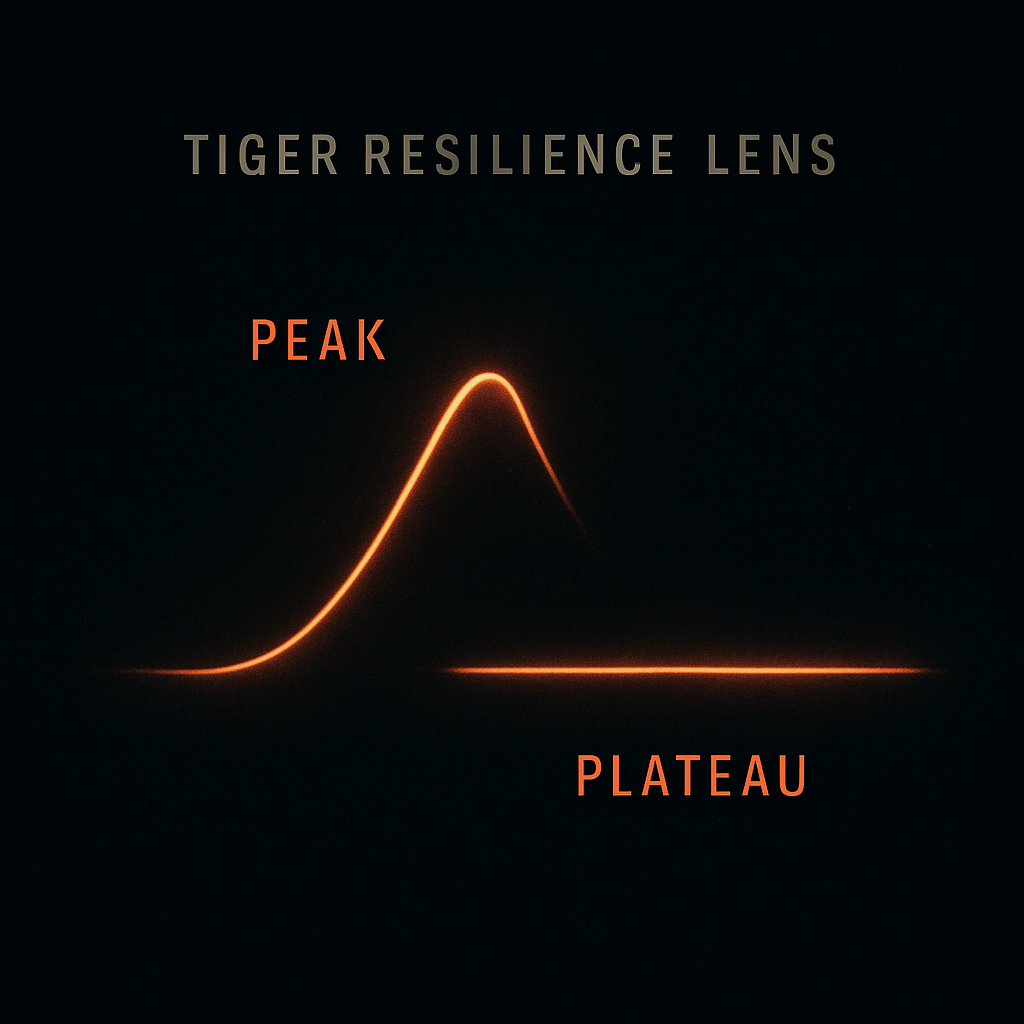
| Tiger Resilience Lens: Peak vs Plateau
We should frame growth as both dynamic and cyclical. You’re either building toward a summit or regrouping on a ledge. That’s why it helps to contrast peak with plateau. Not as good vs bad, but as distinct phases that shape progress differently.
Here's how this contrast plays out across the Four Domains:
|
Domain
|
Peak
|
Plateau
|
|
Body
|
High output, measurable performance spike (PR, race time, capacity jump). The system is firing efficiently under pressure.
|
Adaptation flatline. Output stabilizes, but progress stalls. Useful for consolidation but risky if it lingers too long.
|
|
Mind
|
Focused, sharp, idea-rich. Flow state or deep cognitive clarity. Decision-making speeds up.
|
Cognitive drift or stagnation. Learning slows. Output becomes automatic but uninspired. Often a sign of under-stimulation.
|
|
Heart
|
Emotional intensity. Full engagement, connection, pride, awe, joy. The experience is remembered.
|
Emotional flatness. Not burnout, but low amplitude. Relationships or inner life feel neutral, unchallenged, or repetitive.
|
|
Spirit
|
Sense of alignment and meaning. Direction feels clear. Purpose isn’t abstract, it’s embodied.
|
Numbness or disconnect. Going through motions without clarity. May signal a need to revisit values or re-anchor belief.
|
What matters:
Peaks show you what’s possible. Plateaus show you what’s stable. One stretches you. The other tests your patience and consistency. You need both, but you need to know when you’re in each.
The danger:
Getting stuck in plateau and calling it sustainable. Or hitting a peak and mistaking it for permanence.
The goal:
Use peaks to raise your ceiling. Use plateaus to rebuild your floor. The best performers know how to move between the two, intentionally. |
| | | |
| | | |
| | |
| Michael’s Training Corner: The Art of the Peak
Part 1: Peaking for Performance
Peaking isn’t random. It’s the result of structured stress, adaptation, and timed unloading. Whether you’re preparing for a race, a lift, a tournament, or a major life event, the goal is the same, maximize output on a fixed day without arriving fatigued or flat.
This is what periodization and tapering are for. You build volume and intensity over weeks or months, then pull back at the right time to let fatigue drop and performance rise. That window, usually 1 to 3 weeks depending on the event, is your taper. Done right, it unlocks your peak.
Key principles:
- Volume drops, intensity stays: You’re not coasting, you’re sharpening.
- 30–50% reduction in total volume is common in endurance sports during taper
- Strength athletes typically hit top loads 7–10 days out, then deload
- Nervous system recovery is the limiter. It needs rest to express full power
Warning signs you won’t peak:
- Training through fatigue up to the event
- No variation in training cycle, no overload, no deload
- Mistaking exhaustion for readiness
Peak performance is fragile. It doesn’t show up because you worked hard, it shows up because you worked smart and timed your recovery precisely. It’s more about how you land than how hard you grind.
Part 2: Post-Peak Mindset
After a major peak, there’s often a crash. Not physical, but existential. You hit the goal, cross the line, win the event, and then what?
This is post-peak drift, and it’s predictable. The pursuit provided structure, intensity, and identity. Once that’s gone, it leaves a vacuum unless you’ve planned for it.
Here’s how to navigate it:
1. Reflect before you reset
Don’t rush into the next goal out of habit. Process the peak. What did it show you? What did it cost? What did it confirm?
2. Rebuild your baseline
The goal isn’t to live in a peak. It’s to raise your normal. After the event, return to foundational work. Restore volume, recalibrate effort, and train without pressure for a few weeks.
3. Shift your focus, not your intensity
Peak training is narrow. Post-peak is a chance to go broad. Work on mobility, mechanics, weaknesses. Or shift into a new mode, like going from strength to aerobic base. Keep moving, just shift the load.
4. Avoid the identity trap
You are not the race time, the total on the bar, or the event you trained for. Those are outcomes. Peaks are part of your story, not your definition.
Long-term athletic development, and resilience in general, is built on cycles. Build, peak, recover, rebuild. Plateaus are where you integrate. Peaks are where you reveal. Keep that rhythm, and the results compound. |
| | | |
| | | |
| | | |
| | |
| Real-World Spotlight: Abraham Maslow and the Psychology of Peak
When we talk about peak states beyond sport or performance, Abraham Maslow is the one who gave the concept real weight. Best known for the hierarchy of needs, Maslow was the first to study peak experiences as moments of elevated consciousness, emotional intensity, and deep personal meaning.
He defined them as brief periods where a person feels more fully alive, clear, connected, and in alignment with their values and potential. These aren’t just feel-good flashes, they change how people see themselves and what they believe they’re capable of.
What made Maslow’s take different:
He believed peak experiences weren’t rare or reserved for elite performers. He argued they were accessible, trainable, and deeply human. You could have one watching a sunset, holding your child, or pushing through hardship and realizing what you’re made of. For Maslow, the power wasn’t in the intensity, it was in the aftereffect. People came down from those moments seeing life differently.
He also distinguished between peak experiences and what he called plateau experiences, a concept more people should be paying attention to. While a peak is acute and emotional, a plateau is longer-lasting, quieter, and steadier. It’s the calm confidence that comes from consistent alignment, not intensity. Plateaus are earned through reflection, practice, and perspective. Maslow saw them as the outcome of growth, maturity, and sustained self-actualization.
Why this matters now:
In the context of resilience, Maslow gives us two tools. First, to recognize and value peak moments as personal data, signals of what matters most. And second, to shift focus after the high fades and ask, “How do I integrate this? How do I build a life that reflects what I saw at the top?”
Peaks give clarity. Plateaus give consistency. Maslow respected both. |
| | | |
| | | |
| | | |
| | |
| Journal Exercise: Mapping Your Peak and What Comes After
Use this reflection to identify a recent or meaningful peak, understand what it revealed, and decide how to carry its lessons forward. Take your time. Write honestly. No performance mindset here.
1. Identify the Peak
Think of a moment when your performance, clarity, or emotional intensity was at a high point.
- What was the event or situation
- What made it feel like a peak
- What conditions were in place that allowed you to rise
2. Break Down the Components
Peaks are built on factors you can track and repeat.
- Physically, what was different
- Mentally, what was your focus like
- Emotionally, what was activated
- Spiritually or purpose-wise, what felt aligned
3. Extract the Data
A peak is information. It shows you what is possible.
- What did this moment reveal about your current capacity
- What did it confirm you value
- Did it highlight a strength you underestimate or a weakness you overcame
4. Define the Post-Peak Plan
Avoid the drop that follows a high by deciding what comes next.
- What part of this peak can become part of your baseline
- What habits or structures made the moment possible
- What is one small action this week that moves you forward rather than backward
5. Anchor the Lesson
Summarize in one sentence what this peak taught you that you want to remember.
For more structured prompts, daily reflection space, and guided exercises to build confidence and consistency, explore the journal that pairs with our resilience work.
👉 Awaken the Tiger and Phoenix Self-Esteem Journal
https://www.amazon.com/Awaken-Tiger-Phoenix-build-Esteem/dp/B0DBRWTGS9 |
| | | |
| | | |
| | |
| Final Thoughts: The Five Pillars and the Reality of a Peak
A peak is a moment where everything rises. It shows you the upper limit of your current capacity and gives you a clear look at who you are when you’re fully engaged. But what matters most is what you do once the moment passes. This is where the Five Pillars step in. They turn a peak from a highlight into direction.
Purpose
Purpose determines which peaks matter. Without it, high points feel random or empty. With it, a peak becomes a marker of alignment. It shows you that the work you are doing is connected to something that actually matters to you.
Planning
Peaks are built through structure. Planning sets the timeline, the load, the progression, and the recovery that let you reach your best on a specific day. This is how you engineer a peak rather than stumble into one. It is your deliberate system for arriving prepared.
Practice
You cannot sustain a peak, but you can build the habits that make one possible. Practice is where most of the real work happens. Repetitions that seem ordinary are what raise the ceiling when it is time to perform. This pillar converts intention into capacity.
Perseverance
The climb toward a peak is never linear. Fatigue, setbacks, self-doubt, and life stress test your commitment. Perseverance is what keeps you consistent long enough to reach the moment where everything comes together. It is the endurance behind the summit.
Providence
Peaks often include factors you cannot fully control. Timing, conditions, people, unexpected elements that shape the moment. Providence is the trust that your efforts will meet opportunity. It keeps you grounded after the high fades and reminds you that the path continues.
A peak is not the finish. It is a snapshot of what is possible right now. The Five Pillars give you the framework to rise again with more clarity, more direction, and more capacity. They turn one moment of elevation into the start of what comes next.
Stay Resilient,
Bernie & Michael
Tiger Resilience
📚 References
Atherton, P. J., Smith, K., Etheridge, T., Rankin, D., & Rennie, M. J. (2010). Distinct anabolic signalling responses to amino acids in C2C12 skeletal muscle cells. Amino Acids, 38(5), 1533–1539. https://doi.org/10.1007/s00726-009-0377-x
Areta, J. L., Burke, L. M., Ross, M. L., Camera, D. M., West, D. W. D., Broad, E. M., ... & Coffey, V. G. (2013). Timing and distribution of protein ingestion during prolonged recovery from resistance exercise alters myofibrillar protein synthesis. The Journal of Physiology, 591(9), 2319–2331. https://doi.org/10.1113/jphysiol.2012.244897
Bauer, J., Biolo, G., Cederholm, T., Cesari, M., Cruz-Jentoft, A. J., Morley, J. E., ... & Boirie, Y. (2013). Evidence-based recommendations for optimal dietary protein intake in older people: A position paper from the PROT-AGE Study Group. Journal of the American Medical Directors Association, 14(8), 542–559. https://doi.org/10.1016/j.jamda.2013.05.021
Bilodeau, K. (2019, November 28). Will a purpose-driven life help you live longer? Harvard Health Blog. https://www.health.harvard.edu/blog/will-a-purpose-driven-life-help-you-live-longer-2019112818378
Boyle, P. A., Barnes, L. L., Buchman, A. S., & Bennett, D. A. (2009). Purpose in life is associated with mortality among community-dwelling older persons. Psychosomatic Medicine, 71(5), 574–579. https://doi.org/10.1097/PSY.0b013e3181a5a7c0
Breen, L., & Phillips, S. M. (2011). Skeletal muscle protein metabolism in the elderly: Interventions to counteract the ‘anabolic resistance’ of ageing. Nutrition & Metabolism, 8, 68. https://doi.org/10.1186/1743-7075-8-68
Chan, E. (2025, September 18). Top 100+ workplace diversity statistics: DEI progress & best practices. Second Talent. https://www.secondtalent.com/resources/workplace-diversity-statistics/
Deutz, N. E. P., Bauer, J. M., Barazzoni, R., Biolo, G., Boirie, Y., Bosy-Westphal, A., ... & Singer, P. (2014). Protein intake and exercise for optimal muscle function with aging: Recommendations from the ESPEN Expert Group. Clinical Nutrition, 33(6), 929–936. https://doi.org/10.1016/j.clnu.2014.04.007
Eagleman, D. (2011). Incognito: The secret lives of the brain. Pantheon.
Fuller, R. B. (1975). Synergetics: Explorations in the geometry of thinking. Macmillan.
Jung, C. G. (1953). Two essays on analytical psychology. Routledge & Kegan Paul.
Le Cunff, A.-L. (n.d.). Combinational creativity: The myth of originality. Ness Labs. https://nesslabs.com/combinational-creativity
McEwen, B. S., & Gianaros, P. J. (2011). Stress- and allostasis-induced brain plasticity. Annual Review of Medicine, 62, 431–445. https://doi.org/10.1146/annurev-med-052209-100430
Merriam-Webster. (n.d.). Synthesis. In Merriam-Webster.com dictionary. Retrieved November 9, 2025, from https://www.merriam-webster.com/dictionary/synthesis
Moore, D. R., Robinson, M. J., Fry, J. L., Tang, J. E., Glover, E. I., Wilkinson, S. B., ... & Phillips, S. M. (2009). Ingested protein dose response of muscle and albumin protein synthesis after resistance exercise in young men. American Journal of Clinical Nutrition, 89(1), 161–168. https://doi.org/10.3945/ajcn.2008.26401
Morton, R. W., Murphy, K. T., McKellar, S. R., Schoenfeld, B. J., Henselmans, M., Helms, E., ... & Phillips, S. M. (2018). A systematic review, meta-analysis and meta-regression of the effect of protein supplementation on resistance training-induced gains in muscle mass and strength in healthy adults. British Journal of Sports Medicine, 52(6), 376–384. https://doi.org/10.1136/bjsports-2017-097608
Murphy, T. F. (2018, December 18). The art of integrating emotions for personal growth. Psychology Fanatic. https://psychologyfanatic.com/integrating-emotions-for-personal-growth/
Pascoe, M. C., Thompson, D. R., & Ski, C. F. (2017). Yoga, mindfulness-based stress reduction and stress-related physiological measures: A meta-analysis. Psychoneuroendocrinology, 86, 152–168. https://doi.org/10.1016/j.psyneuen.2017.08.008
Phillips, S. M., & Van Loon, L. J. C. (2011). Dietary protein for athletes: From requirements to optimum adaptation. Journal of Sports Sciences, 29(S1), S29–S38. https://doi.org/10.1080/02640414.2011.619204
Priceonomics (Cima, R.). (2015, September 11). The correlation between arts and crafts and a Nobel Prize. https://priceonomics.com/the-correlation-between-arts-and-crafts-and-a/
Shaffer, F., & Ginsberg, J. P. (2017). An overview of heart rate variability metrics and norms. Frontiers in Public Health, 5, 258. https://doi.org/10.3389/fpubh.2017.00258
Siegel, D. J. (2012). The developing mind: How relationships and the brain interact to shape who we are (2nd ed.). Guilford Press.
Siegel, D. J. (2014, September 16). Brain insights and well-being. https://drdansiegel.com/brain-insights-and-well-being/
Stokes, T., Hector, A. J., Morton, R. W., McGlory, C., & Phillips, S. M. (2018). Recent perspectives regarding the role of dietary protein for the promotion of muscle hypertrophy with resistance exercise training. Nutrients, 10(2), 180. https://doi.org/10.3390/nu10020180
Tiger Resilience. (n.d.). Awaken the Tiger and Phoenix: Build your self-esteem journal. Amazon. https://www.amazon.com/Awaken-Tiger-Phoenix-build-Esteem/dp/B0DBRWTGS9
Thayer, J. F., Åhs, F., Fredrikson, M., Sollers, J. J., & Wager, T. D. (2012). A meta-analysis of heart rate variability and neuroimaging studies: Implications for heart rate variability as a marker of stress and health. Biological Psychology, 90(2), 125–134. https://doi.org/10.1016/j.biopsycho.2012.03.008
Wolf, G. (1996, February). Steve Jobs: The next insanely great thing. Wired, 4(2). https://www.wired.com/1996/02/jobs-2/
Wu, Z., Pandigama, D. H., Wrigglesworth, J., et al. (2023). Lifestyle enrichment in later life and its association with dementia risk. JAMA Network Open, 6(7), e2323690. https://doi.org/10.1001/jamanetworkopen.2023.23690 |
| | | |
|