|
| |
| |
| | |
|
Community and the Power of Collective Influence
|
| | | |
| | |
| Welcome to Our Latest Newsletter!
📚 Read Time: 8 Minutes
Over the past two weeks, we’ve talked about two foundational forces: compounding, how small actions create big change over time, and perspective, how stepping back gives us room to grow. This week, we turn outward to something just as powerful: community.
Not the kind that’s just a group text or a shared space, but the kind that quietly shapes how you think, feel, act, and believe.
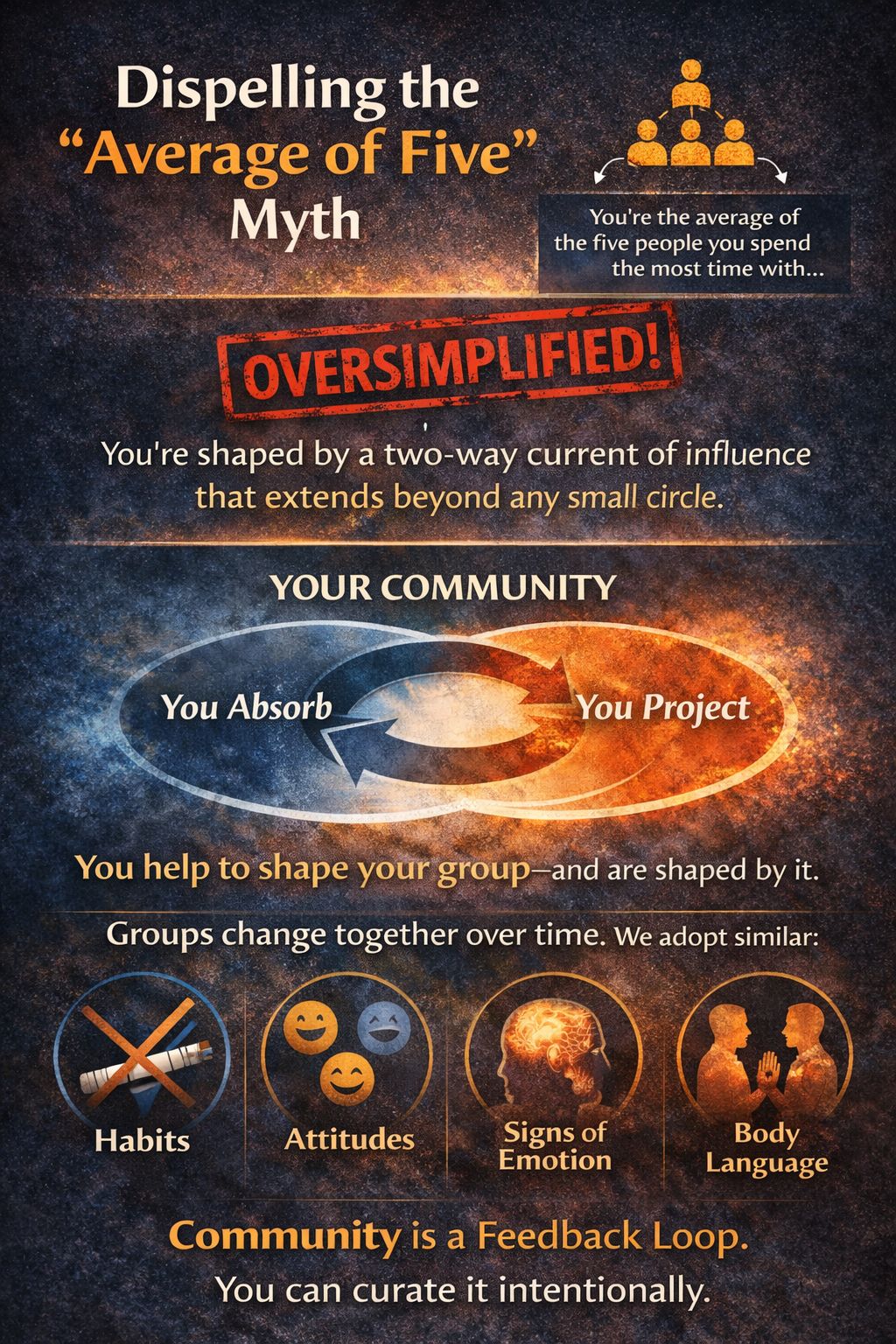
There’s a popular quote that says, “You are the average of the five people you spend the most time with.” It’s catchy, motivational, and not quite accurate. The latest research suggests something different. We don’t just average out. We converge, often toward the most accepted, familiar, or comfortable behaviors in a group. Sometimes that lifts us. Other times, it quietly holds us back.
Here’s the good news. That influence works in both directions, which means you can shape your community with intention. One that supports your values, habits, and growth.
In this week’s issue, we’ll explore:
• Why the “average of five” idea misses the mark
• How community shapes your brain, body, and beliefs more than you realize
• What science says about network effects (yes, your friend’s friend’s habits matter)
• How to tell the difference between a community and a crowd
• Why group training can boost your performance, and when it doesn’t
• Practical ways to assess, build, or reset your own circle of influence
Let’s get into it.
🔗 Want to revisit past editions or share with someone who could use this?
Check out the full Tiger Resilience archive and share to sign up for future newsletters here:
👉 Explore the Tiger Resilience Newsletter Library |
| | | |
| | |
| What Is Community?
Community isn’t just who you live near or who likes your posts. It’s not a group chat or a headcount of acquaintances. In the Tiger Resilience framework, community means a shared environment of mutual influence, support, and aligned norms. It’s the people who show up in your day-to-day life in ways that shape your behavior, beliefs, and sense of belonging.
That includes:
• Friends you speak to regularly
• Family you lean on (or care for)
• Teammates, coworkers, or training partners
• Mentors, role models, or support groups (even online)
True community goes beyond proximity. It’s defined by depth and direction. You can be surrounded by people and still feel alone. Or you can be in a small, tight-knit circle that fuels growth, accountability, and resilience.
At its core, community functions as a two-way current:
• You absorb influence from the people around you
• You project influence back, shaping the norms of the group
Psychologists call this social convergence, over time, groups tend to adopt similar behaviors, attitudes, and even nonverbal patterns. We mirror those we spend the most time with. This can work for or against you depending on the group.
That’s why it matters who you choose to stay close to.
Unlike the old “average of five” idea, we’re not passive reflections of our peers. We’re active participants in the ecosystem that forms around us. The more intentional you are about curating and contributing to your community, the more aligned your environment becomes with your goals and values.
• Want to train harder? Join a circle where effort is normalized
• Want to manage stress better? Spend time around people who regulate, not react
• Want to grow in your career or as a parent? Learn from someone further along who models what “better” looks like
You’re part of a feedback loop that either pushes you forward or keeps you stuck. Community is something you can build and shape intentionally. And it matters more than most people realize. |
| | | |
| | | |
| | |
| The Brain and Body on Community
Community isn’t just a mindset. It’s biological. Human brains evolved to thrive in connection, not isolation. When you engage with people you trust, your brain and body respond in ways that support growth, recovery, and emotional regulation.
In the Brain
Human brains evolved for connection. We’re wired to scan for belonging, support, and shared emotional cues.
Key mechanisms at play:
• Oxytocin: Released during supportive interaction. Lowers cortisol, promotes trust, increases social bonding
• Social pain overlap: Rejection activates the same neural pathways as physical pain
• Mirror neurons: We subconsciously mimic facial expressions, tone, and even posture. This creates emotional contagion, moods ripple through groups
• Synchrony: Brain activity begins to align in connected groups. Laughter, excitement, and even calm are biologically contagious
In close-knit communities, these systems amplify. You don’t just reflect others, you start to feel what they feel. That’s how group energy can either stabilize or dysregulate your nervous system.
In the Body
Social connection doesn’t just feel good, it shows up physiologically.
• Stress regulation: Strong social ties lower baseline cortisol and improve vagal tone
• Immune function: Loneliness increases inflammation and weakens immune response. Supportive relationships reverse that
• Hormonal balance: Community boosts dopamine and serotonin, improving mood, drive, and motivation
• Heart rate variability improves with consistent positive social engagement, a marker of better recovery and resilience
Group settings also influence physical behavior. Sedentary habits, alcohol use, sleep routines, and even diet all shift based on your immediate circle. The more normalized a behavior becomes within your group, the more likely you are to adopt it, good or bad.
The right community doesn’t just lift your mindset. It calibrates your entire nervous system. Who you spend time with quite literally changes your brain, your hormones, and your capacity to recover and perform. |
| | | |
| | | |
| | | |
| | |
| Community by the Numbers
Our behaviors, beliefs, and even biology are shaped by those around us. These six stats show how deeply community drives change, often more than willpower alone.
50% increase in survival
People with strong social relationships live longer. One large meta-analysis found a 50% higher chance of survival among those with meaningful social ties. Chronic loneliness, on the other hand, increases early death risk as much as smoking 15 cigarettes a day. Social connection isn’t just emotional, it’s medical.
Happiness is contagious
A close friend’s happiness raises your own odds of being happy by 15%. Even at two degrees of separation (a friend of a friend), you’re 10% more likely to be happier. At three degrees, the effect is still 6%. Positive emotions ripple through networks, meaning your mental state can uplift people you haven’t even met.
Obesity risk rises by 57%
In a 32-year study, when someone’s close friend became obese, their own odds of becoming obese rose by 57%, even if they lived miles apart. This wasn’t just shared environment. It was shared norms, your sense of what’s “normal” shifts based on the people you know.
Up to 200% more effort with a partner
People who exercised with someone they believed was slightly fitter worked twice as hard, lasting longer and pushing harder. The biggest boost came when participants felt like the “weak link”, they didn’t want to let the group down. Group dynamics create both accountability and intensity.
7x more engaged at work
Employees who have a best friend at work are seven times more likely to be engaged in their job. They’re more productive, have better well-being, and are less likely to leave. Connection at work isn’t a perk, it’s a performance driver.
75% conform to group pressure
In classic psychology studies, about three out of four people agreed with clearly wrong answers just to fit in with a group. Even when the facts were obvious, the pressure to conform won. Community doesn’t just shape mood or behavior, it can override reasoning when the social pull is strong enough. |
| | | |
| | | |
| | |
| Tiger Resilience Lens: Community vs. Crowd
Not all groups are created equal. There’s a big difference between a community (where you have meaningful connection) and a mere crowd (just a bunch of people in the same space or category). Let’s compare how being in a true community versus just part of a crowd impacts key dimensions of our lives:
|
Dimension
|
Community Influence
|
Crowd Influence
|
|
Mind (Mental)
|
Shared clarity and growth. A community challenges you to think bigger and stay accountable to your goals. You feel understood, which frees mental energy for creativity and focus.
|
Diffusion of focus. In a crowd, it’s easy to get mentally lost or distracted. You might conform to popular opinion without true understanding (groupthink), or feel invisible, so you stop sharing your ideas.
|
|
Emotion (Heart)
|
Belonging and support. Community provides emotional safety, you know others care, which boosts confidence and resilience. Positive emotions (joy, hope) amplify as members encourage each other.
|
Anonymity or loneliness. In a crowd you can feel “alone in a sea of people.” Emotional signals are mixed or absent. You might experience surface-level excitement or fear (think mob mentality), but not genuine uplift or empathy.
|
|
Body (Physical)
|
Wellness through accountability. Healthy habits become contagious in a community, friends motivate you to exercise, eat well, recover, and seek care when needed. Stress is buffered because you have allies to talk to, which can even lower blood pressure and cortisol.
|
Physical neglect or stress. A crowd doesn’t check in on your health – no one notices if you skip a meal or a workout. Crowds can even encourage unhealthy behavior (like heavy drinking at a big party) due to peer normalization. If you feel unsafe or unsupported, your body stays in mild “fight or flight” stress mode.
|
|
Behavior (Habits)
|
Positive peer pressure. Community creates gentle pressure to uphold group values. If your running group meets every Saturday, you’ll show up. Good habits are reinforced by group norms – “this is just what we do.” You’re also more likely to drop bad habits that your community discourages.
|
Herd behavior. In a crowd, behavior can become impulsive or unmoored from your values. You might follow along with what “everyone else” is doing, whether it’s productive or destructive, just to not stand out. There’s little accountability; no one will call you out (they don’t know you), so inconsistency creeps in.
|
|
Performance (Growth)
|
Synergy and elevation. In a community, people tend to lift each other up. Teammates share knowledge and give feedback, leading to improvements. Friendly competition in a community setting pushes you to achieve personal bests. You perform with greater purpose because you know it’s contributing to something beyond just you.
|
Competitive stress or stagnation. In a crowd, it can turn into a zero-sum competition or an apathetic atmosphere. You might feel pressure to prove yourself to strangers (performance anxiety) or, alternatively, no motivation to push harder because there’s no shared mission or recognition. It’s easier to plateau when you’re “one of many” without close support.
|
Key insight: Community drives connection and intentional influence, it’s an environment where you’re known and your growth matters to others. Crowd dynamics are more about ambient influence, you may absorb trends or feelings from the masses, but there’s no deliberate support structure. By seeking community and not just company, you harness social influence in a directed, positive way. |
| | | |
| | | |
| | |
| Michael’s Training Corner: The Team Effect (and When to Go Solo)
When used right, training with others can accelerate progress. But it’s not always the answer, and knowing when to go solo is just as important.
We know from both research and experience that training with people who are slightly better than you tends to raise your output. One study found that when participants exercised with someone they believed was ~40% fitter, they more than doubled their workout duration. Why? Because mild mismatch creates pressure, but the right kind. You don’t want to let the group down. You focus more. You push harder. You override your default quit signals.
I’ve seen this play out repeatedly. Whether it’s long runs, lifting, or skill work, being around others who set a higher bar often pulls you up. But the opposite can happen too. I’ve worked with people who spiral when group dynamics don’t align with their pace, temperament, or goals. Some overtrain trying to keep up. Others shut down from constant comparison. The point is: community in training is a performance lever, but only if you know how and when to use it.
If I were building or advising a program, here’s what I’d focus on:
1. Structure the environment intentionally
Use group training for efforts that benefit from shared pacing and morale, like long aerobic work or foundational lifts. That’s where camaraderie helps most. Use small pairings for speed, intensity, or skill work where mismatches could lead to injury or burnout. You want just enough stretch, not overwhelm. Context matters.
2. Leverage smart pairing
The best training partner isn’t necessarily your equal, it’s someone slightly ahead. That asymmetry drives adaptation. If you’re the stronger one, the responsibility to hold a steady pace or demonstrate form builds leadership and consistency. The key is pairing based on goals, not just output.
3. Use peer benchmarking (but apply it correctly)
I’ve seen groups where shared metrics, like weekly mileage, recovery scores, or PRs, create healthy momentum. But it has to be grounded. The benchmark is your past self first. Public wins are celebrated, but the culture reinforces internal progress over external ranking. That keeps people motivated and mentally healthy.
4. Build automatic accountability
Fixed meeting times. Shared logs. Small-group check-ins. These aren’t just about motivation, they reduce decision fatigue. You don’t need to psych yourself up every time. You just show up. And when others expect you there, consistency goes way up without anyone needing to be the “motivator.”
That said, solo work has its place, and skipping it can cost you. Every athlete, at every level, needs sessions where the focus is internal. Where you’re tuning into your own pacing, effort, mindset, without the distortion of group energy. I recommend scheduling at least one solo session per week to recalibrate. It protects you from chasing others’ goals or slipping into someone else’s rhythm.
Also worth noting: not everyone is wired for group energy. If you’re more introverted or sensitive to comparison, the group effect might drain you more than it drives you. In those cases, a single trusted partner or even an asynchronous online community might be more effective. The format matters less than the function, what creates consistency, challenge, and alignment for you? |
| | | |
| | | |
| | | |
| | |
| Real-World Spotlight: Dr. Nicholas Christakis and the Network Effect
Dr. Nicholas Christakis, a physician and network scientist, changed the way we understand community. His research showed that health, habits, and emotions spread through social networks, not just through direct contact, but through multiple degrees of influence.
Working with James Fowler, Christakis mapped social data from thousands of participants and found that traits like happiness, smoking, and even loneliness ripple through communities like behavioral chain reactions.
Here’s what stands out:
• Influence reaches three degrees out. Your friend’s friend’s friend, someone you’ve never met, can still impact your behavior or mood. The effect fades with each degree, but it’s real and measurable.
• Positive change has a stronger signal. Happiness spreads more effectively than unhappiness, and healthy behaviors tend to cascade more reliably than harmful ones. That’s good news for resilience.
• It’s not about proximity, it’s about connection. Physical closeness doesn’t matter. What matters is whether there’s a social bond. Influence travels along emotional and relational lines, not geographic ones.
• Norms, not just behavior, are what move. People in your network shift your perception of what’s typical or acceptable. Over time, that can reshape your own habits. without you noticing.
• Some ties carry more weight. Close, same-gender friendships had stronger influence than weaker or more distant ties in certain behaviors. Not all nodes in your network have equal impact.
Christakis emphasizes that networks are dynamic systems. We’re not just affected by them, we also shape them. By improving our own habits or mindset, we can spark ripples that affect dozens of others over time. This means personal growth isn’t just self-help, it’s social influence with reach.
His message is simple: invest in high-quality connections, model the values you care about, and be deliberate about the communities you build. You're not just choosing who to spend time with. You're shaping a social environment that affects you, and people you'll never even meet. |
| | | |
| | | |
| | | |
| | |
| 📝 Interactive Journal Exercise: Audit Your Network
Take a moment to zoom out and look at your ecosystem, not just your inner circle, but the broader web of people who influence your habits, mindset, and energy. This isn’t about judgment. It’s about awareness and alignment.
Step 1: Map your top influences
List 5–10 people you interact with most often, family, friends, colleagues, training partners, online connections. Ask:
- Who consistently challenges me to grow?
- Who drains me or keeps me stuck?
- Who models the habits I want more of?
- Who subtly shifts my standards up, or down?
Step 2: Look for convergence
Where are you already syncing with your environment? Where are you adapting without realizing it? Think about:
- Health: Are my eating, sleeping, or activity habits shaped by my circle?
- Mindset: Do I think bigger or smaller because of the people around me?
- Emotional tone: Am I becoming more optimistic, reactive, resilient… or less?
Step 3: Identify one upgrade
Choose one shift to make in the next two weeks, either lean in to a connection that lifts you, or step back from one that doesn’t. Small moves matter. It might be:
- Reaching out to someone who inspires you
- Creating boundaries around draining interactions
- Joining a group or space where your goals feel supported
- Scheduling a solo session to reset your baseline
Remember: You don’t have to overhaul your entire network. But you do have power to tilt it, one decision, one conversation, one habit at a time.
For more structured prompts, daily reflection space, and guided exercises to build confidence and consistency, explore the journal that pairs with our resilience work.
👉 Awaken the Tiger and Phoenix Self-Esteem Journal
https://www.amazon.com/Awaken-Tiger-Phoenix-build-Esteem/dp/B0DBRWTGS9 |
| | | |
| | | |
| | |
| Final Thoughts: Community and the 5 Pillars
Community can either reinforce or quietly undermine each of the Five Pillars. Here’s how:
Purpose
The right people keep your mission front and center. They believe in your “why” and reflect it back when you forget. The wrong crowd? They can chip away at it through subtle doubt or disinterest. Align with those who support your vision, not dilute it.
Planning
Shared accountability sharpens planning. Whether it’s syncing calendars, trading tips, or reminding each other of goals, a proactive community improves follow-through. A scattered or passive circle does the opposite. Surround yourself with planners, and you’ll start thinking ahead by default.
Practice
Consistency thrives in community. Showing up gets easier when others are doing the same. Think group workouts, writing sessions, or study squads. If no one around you values disciplined practice, it’s harder to hold the line alone. Choose a crew that trains, builds, and learns consistently.
Perseverance
Support doesn’t erase hardship, it gives you the fuel to keep going. In tough moments, encouraging voices and shared stories of resilience make the difference. Quitting becomes less tempting when you’re not struggling in silence. Be with people who stay standing when it’s hard.
Providence
Opportunity often comes from others. Communities expand your surface area for luck, introductions, ideas, insights, and unexpected doors opening. A strong network increases the odds that when preparation meets chance, you’re ready and reachable.
In the end, community doesn’t just influence your path, it shapes your internal compass. It affects what you think is normal, what you believe is possible, and what you’re willing to try. Choose wisely. Be intentional. And remember: the energy you bring into your community feeds the ripple. What you put out matters.
Surround yourself with those who lift, not drift. And when in doubt, be that person for someone else.
Stay Resilient,
Tiger Resilience
📚 References
Christakis, N. A., & Fowler, J. H. (2007). The spread of obesity in a large social network over 32 years. New England Journal of Medicine, 357(4), 370–379. https://doi.org/10.1056/NEJMsa066082
Christakis, N. A., & Fowler, J. H. (2008). The collective dynamics of smoking in a large social network. New England Journal of Medicine, 358(21), 2249–2258. https://doi.org/10.1056/NEJMsa0706154
Fowler, J. H., & Christakis, N. A. (2008). Dynamic spread of happiness in a large social network: longitudinal analysis over 20 years in the Framingham Heart Study. BMJ, 337, a2338. https://doi.org/10.1136/bmj.a2338
Holt-Lunstad, J., Smith, T. B., & Layton, J. B. (2010). Social relationships and mortality risk: a meta-analytic review. PLoS Medicine, 7(7), e1000316. https://doi.org/10.1371/journal.pmed.1000316
Cacioppo, J. T., & Cacioppo, S. (2014). Social relationships and health: The toxic effects of perceived social isolation. Social and Personality Psychology Compass, 8(2), 58–72. https://doi.org/10.1111/spc3.12087
Heinrichs, M., Baumgartner, T., Kirschbaum, C., & Ehlert, U. (2003). Social support and oxytocin interact to suppress cortisol and subjective responses to psychosocial stress. Biological Psychiatry, 54(12), 1389–1398. https://doi.org/10.1016/S0006-3223(03)00465-7
Kosfeld, M., Heinrichs, M., Zak, P. J., Fischbacher, U., & Fehr, E. (2005). Oxytocin increases trust in humans. Nature, 435(7042), 673–676. https://doi.org/10.1038/nature03701
Rizzolatti, G., & Craighero, L. (2004). The mirror-neuron system. Annual Review of Neuroscience, 27, 169–192. https://doi.org/10.1146/annurev.neuro.27.070203.144230
Hasson, U., Ghazanfar, A. A., Galantucci, B., Garrod, S., & Keysers, C. (2012). Brain-to-brain coupling: a mechanism for creating and sharing a social world. Trends in Cognitive Sciences, 16(2), 114–121. https://doi.org/10.1016/j.tics.2011.12.007
Eisenberger, N. I., Lieberman, M. D., & Williams, K. D. (2003). Does rejection hurt? An FMRI study of social exclusion. Science, 302(5643), 290–292. https://doi.org/10.1126/science.1089134
Irwin, B. C., Scorniaenchi, J., Kerr, N. L., Eisenmann, J. C., & Feltz, D. L. (2012). Aerobic exercise is promoted when individual performance affects the group: A test of the Kohler motivation gain effect. Annals of Behavioral Medicine, 44(2), 151–159. https://doi.org/10.1007/s12160-012-9367-4
Rath, T., & Harter, J. K. (2010). Wellbeing: The Five Essential Elements. Gallup Press.
Gallup. (2022). State of the Global Workplace Report. https://www.gallup.com/workplace
Asch, S. E. (1955). Opinions and social pressure. Scientific American, 193(5), 31–35.
Bond, R., & Smith, P. B. (1996). Culture and conformity: A meta-analysis of studies using Asch’s line judgment task. Psychological Bulletin, 119(1), 111–137. https://doi.org/10.1037/0033-2909.119.1.111
Umberson, D., Crosnoe, R., & Reczek, C. (2010). Social relationships and health behavior across the life course. Annual Review of Sociology, 36, 139–157. https://doi.org/10.1146/annurev-soc-070308-120011
Southwick, S. M., Bonanno, G. A., Masten, A. S., Panter-Brick, C., & Yehuda, R. (2014). Resilience definitions, theory, and challenges: interdisciplinary perspectives. European Journal of Psychotraumatology, 5(1), 25338. https://doi.org/10.3402/ejpt.v5.25338
Ozbay, F., Johnson, D. C., Dimoulas, E., Morgan, C. A., Charney, D., & Southwick, S. (2007). Social support and resilience to stress: from neurobiology to clinical practice. Psychiatry (Edgmont), 4(5), 35–40. |
| | | |
|