|
| |
| |
| | |
|
Capacity: Building Your Ability to Do More (and Stress Less)
|
| | | |
| | |
| Welcome to Our Latest Newsletter!
📚 Read Time: 10 Minutes
December stretches people thin. Routines break. Time gets pulled in ten directions. Expectations rise, even as energy dips. In the blur of the holiday season, most people try to keep up, but few stop to ask what they’re actually capable of carrying.
This week’s topic is capacity. Not just how much you can handle, but how you build toward more. In performance, health, and daily life, capacity determines whether you break down or break through. And in a season when demands stack up quickly, understanding your true capacity, mentally, physically, emotionally, becomes a competitive edge and a survival skill.
This edition breaks it all down:
• What capacity really is (and how it differs from capability)
• How the brain and body expand or erode capacity under stress
• The science of training capacity: aerobic, strength, and recovery
• Six data points that show why capacity is the foundation of growth
• How to build a system that protects and expands your capacity over time
🔗 Want to revisit past editions or share with someone who could use this?
Check out the full Tiger Resilience archive and share to sign up for future newsletters here:
👉 Explore the Tiger Resilience Newsletter Library |
| | | |
| | |
| The Capacity Gap
By Michael Tiger
There’s a version of me I haven’t reached yet. The one who runs faster, handles more volume, executes at a higher level in business, and shows up consistently in the life I’m building with my wife. That version is not an ideal. It’s what I know I’m capable of. The difference between that version and who I am today is the Capacity Gap.
Legendary football coach Nick Saban calls it the space between what you’re capable of and what you’re currently delivering on. Most people underestimate their ceiling and overestimate how close they are to it. That’s the hard truth. I’ve lived it.
In running, I’m training for performance. Trying to build speed, durability, and long-range output. I see progress. But I also see how far I still have to go. My legs can only go as fast as my aerobic system allows. My endurance can only stretch as far as my recovery can support. The gap doesn’t lie. It shows up when pace fades at the end of a session, or when I don’t have another gear on a long run. And the only way to close that is through work. Not guessing. Not hoping. Actual, measurable training.
In business, it’s the same. The vision we have for Tiger Resilience requires more from me. More structure, better leadership, more consistency in what I create and deliver. There are days I meet that standard. There are days I don’t. The capability is there. But the execution isn’t always. When I get honest about that gap, it forces me to focus not on doing more, but on doing better. Sharper planning. Clearer systems. Less wasted motion.
And in life, I feel it with my wife. The future we’re building demands more capacity than I’ve had in the past. Emotional steadiness. Time management. Clear communication. There’s no training plan for that, but there is effort. If I show up after a long day with nothing left to give, it’s not because I don’t care. It’s because I haven’t built the margin to carry what matters outside of work and training. That’s a capacity issue.
The Capacity Gap isn’t a weakness. It’s just feedback. It tells you what you’re ready for and what you’re not. And it doesn’t shrink by talking about it. It shrinks when you decide to train for it.
That’s what I’m working on this season. Not just hitting a race time. Not just growing a business. Not just being “better” in my relationship. I’m trying to build the capacity to sustain all of it. That means better sleep. More strategic training. More deliberate recovery. More intention in how I spend time and energy.
It’s not a sprint. It’s a build. And it never ends.
So ask yourself: What are you capable of? What are you actually doing? And what systems, structure, and support do you need to close that gap?
Because the version of you that can handle more isn’t a future fantasy. It’s someone you can build.
Brick by brick. Session by session. Day by day. |
| | | |
| | |
| What Is Capacity?
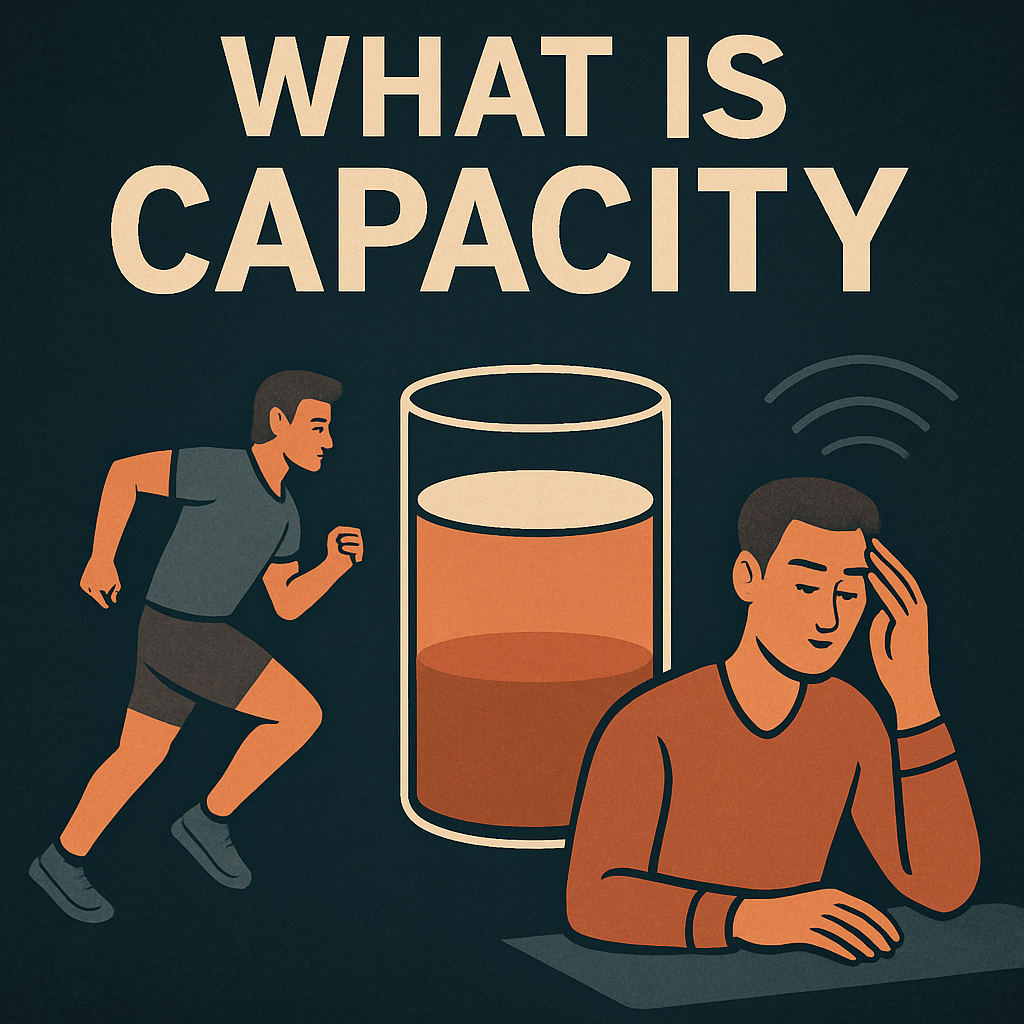
Capacity is your ability to handle and recover from stress. Physically, it’s how much work your body can take on, adapt to, and come back stronger from. Mentally, it’s the bandwidth you have to stay focused, make decisions, and manage pressure without slipping into overwhelm or reactivity.
Unlike capability, which is about specific skills or outputs, capacity is the system behind it all. It’s the size of the container. The nervous system, the cardiovascular system, the muscular system, the cognitive and emotional systems, they all determine what fits inside your day before something cracks.
Capacity isn’t built by going to your limit once. It expands through consistent exposure, smart recovery, and integration across domains. A well-developed capacity lets you:
• Train harder without breaking down
• Recover faster without losing momentum
• Stay composed longer under pressure
• Respond to adversity with flexibility instead of collapse
It’s not just about doing more. It’s about being able to handle more with less cost. That’s the difference between progress and burnout |
| | | |
| | | |
| | |
| The Brain and Body on Capacity
Capacity shows up in how your systems respond to repeated effort. When built well, it gives you more physical headroom, sharper mental regulation, and stronger recovery mechanisms.
🧠 Brain: Stress Regulation, Focus, and Adaptation
• Prefrontal Cortex Efficiency
This region handles attention, decision-making, and emotional control. When capacity is strong, the prefrontal cortex stays online longer under stress, helping you stay focused in hard intervals or chaotic environments.
• HPA Axis Conditioning
The hypothalamic-pituitary-adrenal (HPA) axis manages your stress response. Consistent training and exposure to controlled challenge lower baseline cortisol levels, reduce overreaction to pressure, and prevent burnout.
• Neuroplastic Load Tolerance
The brain becomes more efficient at managing fatigue and discomfort signals. This leads to sharper pacing judgment, less emotional volatility mid-session, and more deliberate recovery choices.
🩺 Body: Energy Systems, Recovery, and Integration
• Mitochondrial Density and Aerobic Efficiency
A high-capacity system has more and denser mitochondria, especially from aerobic intervals with short rest. That means more energy with less fatigue, better fat oxidation, and quicker between-set recovery.
• Muscle Fiber Recruitment and Stress Tolerance
Stronger capacity means more efficient high-threshold motor unit activation during hard reps or speedwork. This improves power and reduces the cost of intensity.
• Nervous System Recovery
High-capacity athletes can return to baseline quicker post-stressor. Heart rate variability (HRV) stabilizes faster, inflammation markers drop sooner, and muscular recovery windows shrink, especially when sleep, nutrition, and breathing are aligned.
At its core, capacity is physiological margin. It is not what you do once. It is what you can repeat. What you can recover from. What you can sustain. |
| | | |
| | | |
| | | |
| | |
| Capacity by the Numbers
Sometimes capacity is best understood in hard data. These six stats reveal how quickly it can grow or fade, and why it’s about far more than just performance output:
• ~7%
The average decline in aerobic capacity after just 2 to 4 weeks off from training. That’s how fast the engine starts to shrink without a signal. Extended breaks? Losses of 15%+ aren’t uncommon.
• 72 hours
The time your nervous system may need to fully recover from a sprint session or heavy lift to failure. High-output work demands space to rebuild. Skip the rest, and capacity doesn’t rise, it fractures.
• 2%
The size increase in your hippocampus after a year of consistent aerobic training. This brain region controls memory and learning. You’re not just building lungs and legs, you’re literally growing cognition.
• 80/20
The intensity ratio elite endurance athletes follow: 80% easy, 20% hard. This split builds massive aerobic reserves without frying the system. Most people train the opposite, and wonder why they plateau.
• 4–6 weeks
The time it takes for mitochondrial function to significantly decline without aerobic work. You may not notice it right away, but your cellular engine is already shrinking.
• 24 hours
The effect of one night without sleep: your cognitive performance tanks to the equivalent of being legally drunk. That’s what happens when recovery disappears. No body or brain can operate at full capacity without it. |
| | | |
| | | |
| | |
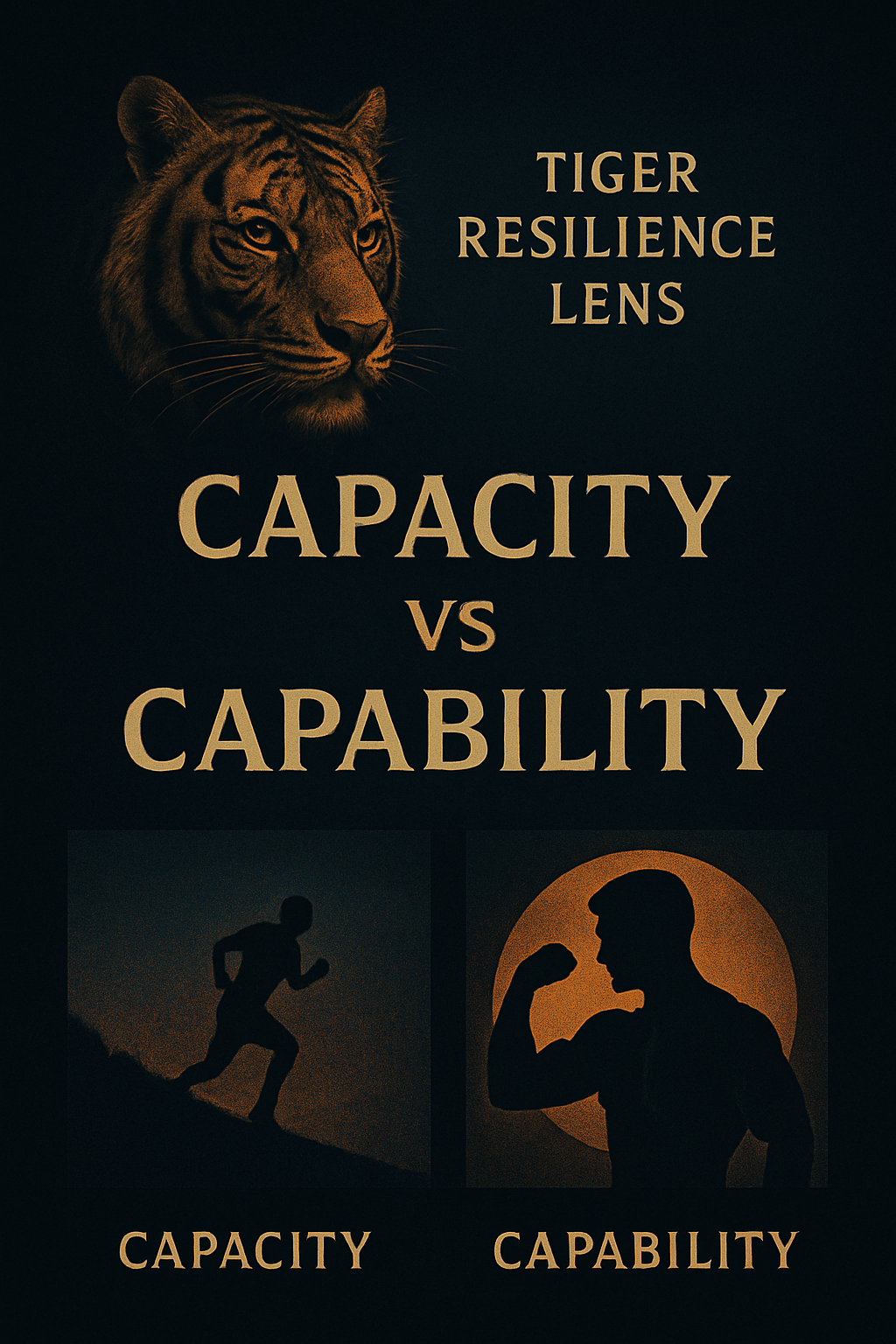
| Tiger Resilience Lens: Capacity vs Capability
These two terms get used interchangeably, but they shape your growth in very different ways. Capability is what you can do in the moment. Capacity is what you are able to sustain and adapt to over time.
|
Domain
|
Capacity
|
Capability
|
|
Body
|
The total volume of work you can handle and recover from. Built slowly through consistency, recovery, and progressive overload.
|
A snapshot of performance. How fast, strong, or powerful you are in a given moment or test.
|
|
Mind
|
Your ability to maintain focus, regulate emotion, and return to center even under stress.
|
Your sharpness in a single moment. How well you can problem-solve or respond to a challenge right now.
|
|
Heart
|
The depth of resilience you bring to setbacks and adversity. You can absorb struggle without breaking.
|
Your emotional readiness or willpower in a given situation. It might be strong today, weaker tomorrow.
|
|
Spirit
|
A long-view alignment with purpose. The ability to stay engaged over seasons and cycles, not just in high-energy bursts.
|
A short-term surge of inspiration or clarity. Important, but often fleeting.
|
Key Distinction:
- Capability is your output.
- Capacity is your bandwidth.
Capability wins a rep, a race, or a moment. But capacity builds a life. It’s the expanded "pipe" that lets you carry more work, more stress, more meaning, without burning out or breaking down.
You don’t rise to your highest capability. You fall to your level of capacity. That’s why we train it. |
| | | |
| | | |
| | |
| Michael’s Training Corner: Building Capacity in Real Time
Capacity is the foundation beneath performance. It’s not just how fast you can go or how much you can lift. It’s your ability to do more work, recover faster, and stay in the game longer without breaking down. Most people chase capability. The best athletes train capacity.
🧱 Capacity Is Built, Not Found
You don’t wake up one day with more capacity. You earn it through weeks and months of consistent inputs. Every easy run, aerobic rep, strength circuit, and recovery session is a brick in the wall.
At Tiger Resilience, I coach capacity in training through a few core strategies:
1. Aerobic Intervals for the Long Game
These are not all-out efforts. They’re controlled, repeatable intervals at moderate intensities with short recovery. The goal isn’t to push limits. It’s to expand the base without spiking fatigue.
Example: 6x3 minutes at 80–85% max effort with 60s jog rest. Zone 2–3 range, just under threshold. Breath controlled. Smooth form. Minimal drop-off.
This teaches your system to stay efficient while under steady stress. More capillaries. Better oxygen delivery. Higher mitochondrial density. It’s how you build a bigger engine.
2 Strength That Supports, Not Sabotages
You don’t need max lifts to build capacity. You need movement quality, postural integrity, and usable strength that transfers to your sport or life demands.
We prioritize:
• Compound lifts at moderate loads (70–80% 1RM)
• Antagonist balance: pushing and pulling, hinging and squatting
• Eccentric control to support tendon and joint health
Think: capacity isn’t the weight you lift once. It’s the strength that keeps your posture solid at mile 20 or your form clean under fatigue.
3. Progressive Load. Deliberate Recovery.
Every training plan needs two tracks: what you build and what you absorb.
We follow the model: 3–4 weeks of structured build with a potential deload based on fatigue markers and training intensity. A deload is not a fixed rule. It’s a tool. If intensity is managed well, a full deload after just 3–4 weeks may not be necessary.
We anchor weeks around key sessions, not just “more work.” Max-effort training (like sprint repeats or heavy lifts) can take 48–72 hours for full neurological recovery. Skip that and you stop adapting. Recovery isn’t the pause. It’s the multiplier.
4. Don’t Skip General Fitness
Before race pace or peak intensities, we hammer general fitness. That means:
• Easy aerobic runs
• Tempo efforts just under threshold
• Stability and mobility circuits
• High-rep strength circuits at lower loads
This work is unglamorous but essential. It builds the connective tissue, aerobic density, and neuromuscular control that lets you handle more specific demands later.
5. Link Strength and Endurance Together
Capacity is not built in silos. We combine systems:
• Hill circuits with bodyweight or weighted movements between reps
• Post-lift aerobic finishers (row, bike, or tempo run)
• Breathing work that teaches regulation under effort
Why? Because real life is blended. Races don’t care if you’re “strong” or “fit.” They demand both. So we train that intersection.
6. Simplicity Over Sophistication
Most breakthroughs come from doing the basics longer and better than everyone else. The secret isn’t hidden in a fancy protocol. It’s in repeating small wins until they become your baseline.
Show up. Work just under your ceiling. Recover like it’s part of the plan. Repeat. That’s how capacity grows. |
| | | |
| | | |
| | | |
| | |
| Real-World Spotlight: Tony Schwartz – The Art of Expanding Energy Capacity
When it comes to building real-world capacity for high performance, few have shaped the conversation like Tony Schwartz. A former journalist turned performance coach, Schwartz co-authored The Power of Full Engagement with psychologist Jim Loehr, a book that became a cornerstone in modern workplace culture. Its core principle? “Managing energy, not time, is the key to high performance and personal renewal.”
Schwartz reframed the way we think about productivity, not as something you grind through, but as something you train for. He taught that to consistently operate at your best, you don’t need to push harder. You need to expand your energy capacity and recover with intention. What he did was take ideas rooted in elite sports and apply them to everyday life, from boardrooms to classrooms.
Key insights from Tony Schwartz that define capacity in action:
- Energy is renewable: Schwartz argued that just like a physical system, your personal energy can be depleted, but it can also be replenished through sleep, breaks, movement, and joy. You don’t have to settle for running on fumes.
- Work in sprints, not marathons: Inspired by interval training, Schwartz taught people to work in focused 90-minute blocks, followed by short recovery breaks. Over time, this leads to more output, not less.
- Rituals build resilience: From early wake-up routines to tech-free evenings, Schwartz emphasized structured habits to preserve capacity and reduce decision fatigue. His message was simple: resilience isn’t spontaneous, it’s scheduled.
- Purpose fuels performance: In his work with companies, Schwartz found that people who aligned their daily work with personal values consistently outperformed their peers. Tapping into purpose became a source of deep, sustainable energy.
- More energy, better results: One of Schwartz’s biggest breakthroughs was showing that investing in capacity actually boosts output. For example, clients who started exercising regularly or slept more didn’t lose productivity, they gained it through better focus, mood, and decision-making.
- Stress without recovery is sabotage: He made it clear that stress itself isn’t the problem, it’s the lack of balance. Just as muscles grow with rest after effort, so does your capacity for high-level performance. Burnout, in his view, isn’t a badge of honor. It’s a sign of mismanaged energy.
Through his firm, The Energy Project, Schwartz worked with organizations like Google, Coca-Cola, and the LAPD to put these ideas into action. His legacy lives in today’s growing emphasis on workplace wellness, performance rituals, and human sustainability. He doesn't just teach people how to work, but how to expand what they’re capable of without burning out. |
| | | |
| | | |
| | | |
| | |
| 📝 Journal Exercise: Expanding Your Capacity – A Personal Plan
Capacity isn’t built in breakthroughs. It’s built in the small stretches we choose, again and again. This week’s journaling prompt helps you uncover where you’re hitting your threshold, and how to gently push that line forward.
1. Spot Your Limiter
Think of a recent time you felt at your limit, physically, mentally, or emotionally. Maybe it was mid-run, mid-meeting, or mid-meltdown. Whatever the moment, write it out in detail:
- What were you doing when you hit the wall?
- How did it feel, physically and mentally?
- What did you do next: stop, shut down, push through?
Example: “During Friday’s tempo run, I hit the third interval and my form collapsed. I couldn’t control my breathing. I slowed down and cut it short, frustrated.”
2. Understand the Cause
Every capacity limit has roots. List a few likely contributors:
- Did you train too hard the days before?
- Was your sleep, nutrition, or recovery off?
- Were you stressed emotionally or distracted mentally?
Most breakdowns are predictable when you zoom out. That’s the power of reflection, next time, you’ll see it coming.
3. Pick One Area to Expand
Choose a single dimension, physical, mental, or emotional, that you want to improve over the next 2–3 weeks. Write it down:
“I want to increase my ___ capacity.”
(e.g., aerobic endurance, concentration span, emotional composure in conflict)
4. Design a Micro-Challenge
Capacity grows through consistent, recoverable stress. Choose one micro-challenge to repeat 3–4 times this week:
- Physical: Add 10% volume to an aerobic session or 1–2 extra sets in the gym. Not max effort, just more time under tension.
- Mental: Stretch your focus with a 30-minute deep work block (no distractions), followed by 5 minutes of reset.
- Emotional: Stay present 15 minutes longer in a situation that usually drains you, and step away briefly to recover.
Write: “On [days], I will ___.”
(e.g., “Tuesday and Friday, I’ll add one 5-minute jog interval post-run.”)
5. Plan Your Recovery
Without recovery, you’re not expanding capacity, you’re just exhausting it.
- After each session, I’ll: ___
(e.g., breathe for 5 minutes, walk, hydrate, stretch)
- This week, I’ll support recovery by: ___
(e.g., sleeping 7+ hours, limiting screens before bed, eating post-training protein)
6. Reflect + Adjust
After 1–2 weeks, come back to these prompts:
- What got easier?
- What surprised you?
- What recovery habits helped the most?
- Where did you grow, and where do you still feel stuck?
This is where the gains take root. Write a short reflection, and keep going.
For more structured prompts, daily reflection space, and guided exercises to build confidence and consistency, explore the journal that pairs with our resilience work.
👉 Awaken the Tiger and Phoenix Self-Esteem Journal
https://www.amazon.com/Awaken-Tiger-Phoenix-build-Esteem/dp/B0DBRWTGS9 |
| | | |
| | | |
| | |
| 🔚 Final Thoughts: Capacity Is What You Build
Capacity isn’t a mystery. It’s not gifted to the talented or reserved for the elite. It’s a skill, built, stretched, tested, and renewed through how you train, how you recover, and how you show up day after day. The best athletes, leaders, and performers don’t just have more time or talent. They’ve learned how to manage stress, energy, and attention in a way that expands their limits rather than burns them out.
Here’s how that connects back to the five Tiger Resilience pillars:
• Purpose:
Capacity begins with clarity. When you know why you’re building, whether for health, family, competition, or legacy, you’ll stay grounded when effort starts to bite.
• Planning:
Progress without a system is a gamble. We train in cycles, not chaos. Whether it’s a micro-challenge in your journal or a 3-week aerobic block, capacity is built from deliberate structure,not just grinding harder.
• Practice:
This is where capacity becomes reality. The long runs, focused work sprints, or emotional composure reps with your kids all build your baseline. Small, repeated exposures, layered over time, are what move the needle.
• Perseverance:
Expanding capacity means brushing up against failure. You will hit your limit. The key is learning to stay with it, not forcefully, but wisely. Knowing when to push and when to pull back is its own form of mastery.
• Providence:
You’re not meant to carry this alone. Whether it’s a training partner, a spiritual anchor, or just deep trust in the process, you need something larger to sustain your belief on the hard days.
Capacity isn’t just how much you can do. It’s how well you can grow under pressure, adapt under fatigue, and return stronger from the edges of effort. And the truth is, most people are far from reaching theirs.
You just have to choose to build it.
Stay Resilient,
Tiger Resilience
📚 References
Proceedings of the National Academy of Sciences, 108(7), 3017–3022. https://doi.org/10.1073/pnas.1015950108
Farnam Street. (n.d.). The Power of Full Engagement Summary. Farnam Street. https://fs.blog/the-power-of-full-engagement/
Fiskerstrand, A., & Seiler, S. (2004). Training and performance characteristics among Norwegian international rowers 1970–2001. Scandinavian Journal of Medicine & Science in Sports, 14(5), 303–310. https://doi.org/10.1111/j.1600-0838.2003.367.x
Hoppeler, H., & Flück, M. (2003). Plasticity of skeletal muscle mitochondria: Structure and function. Medicine & Science in Sports & Exercise, 35(1), 95–104. https://doi.org/10.1249/01.MSS.0000044115.58434.B7
Killgore, W. D. S. (2010). Effects of sleep deprivation on cognition. Progress in Brain Research, 185, 105–129. https://doi.org/10.1016/B978-0-444-53702-7.00007-5
Loehr, J., & Schwartz, T. (2003). The Power of Full Engagement: Managing energy, not time, is the key to high performance and personal renewal. Free Press.
Maguire, S. (2014). The Science of Running: How to find your limit and train to maximize your performance. Origin Press.
McEwen, B. S. (2007). Physiology and neurobiology of stress and adaptation: Central role of the brain. Physiological Reviews, 87(3), 873–904. https://doi.org/10.1152/physrev.00041.2006
Mujika, I., & Padilla, S. (2000). Detraining: Loss of training-induced physiological and performance adaptations. Part I: Short term insufficient training stimulus. Sports Medicine, 30(2), 79–87. https://doi.org/10.2165/00007256-200030020-00002
Sapolsky, R. M. (2004). Why Zebras Don't Get Ulcers (3rd ed.). Henry Holt and Company.
Schwartz, T. (n.d.). The Energy Project. Retrieved from https://theenergyproject.com
Seiler, S. (2010). What is best practice for training intensity and duration distribution in endurance athletes? International Journal of Sports Physiology and Performance, 5(3), 276–291. https://doi.org/10.1123/ijspp.5.3.276
Shulkin, M., & Gold, S. (2019). Peak performance under pressure: The science of stress, performance, and recovery. HarperWave.
Siff, M. C. (2003). Supertraining (6th ed.). Supertraining Group.
Walker, M. (2017). Why We Sleep: Unlocking the Power of Sleep and Dreams. Scribner.
Williamson, A. M., & Feyer, A. M. (2000). Moderate sleep deprivation produces impairments in cognitive and motor performance equivalent to legally prescribed levels of alcohol intoxication. Occupational and Environmental Medicine, 57(10), 649–655. https://doi.org/10.1136/oem.57.10.649
Zatsiorsky, V. M., & Kraemer, W. J. (2006). Science and practice of strength training (2nd ed.). Human Kinetics.
BigSpeak Speakers Bureau. (n.d.). Tony Schwartz. https://www.bigspeak.com/speakers/tony-schwartz/
Clear, J. (2018). Atomic Habits: An Easy & Proven Way to Build Good Habits & Break Bad Ones. Avery.
Saban, N. (2021). [Interview with Holly Rowe, ESPN]. Referenced in media coverage of the “Capability Gap” concept.
Kabat-Zinn, J. (1990). Full Catastrophe Living: Using the Wisdom of Your Body and Mind to Face Stress, Pain, and Illness. Delta.
Fitzgerald, M. (2009). Brain Training for Runners: A Revolutionary New Training System to Improve Endurance, Speed, Health, and Results. NAL. |
| | | |
|