|
| |
| |
| | |
|
Perspective: Why It Matters More Than Motivation
|
| | | |
| | |
| Welcome to Our Latest Newsletter!
📚 Read Time: 8 Minutes
Happy New Year!
This week’s topic came from a simple moment. My father-in-law sent me an article that really caught my attention. It was about awe, how moments of wonder, whether through nature, walking, or simply slowing down, can shift how we see ourselves and our lives.
At first glance, it felt obvious. Of course stepping back helps. Of course perspective matters.
But the more I sat with it, the more I realized how often we overlook this entirely.
Perspective isn’t something most people consciously work on. We talk about motivation. Discipline. Goals. Resolutions. But we rarely talk about the lens through which we interpret effort, setbacks, progress, or even our own bodies. And that lens quietly shapes everything.
Awe, as the article described, is one way perspective changes. It pulls us out of tunnel vision. It reminds us that our current stress, frustration, or self-criticism is only one frame in a much bigger picture. And when that picture expands, behavior changes with it.
This felt especially relevant at the start of a new year.
Right now, people are setting resolutions. Training plans. Career goals. Health goals. Many of them will fail. Not because people don’t want change badly enough, but because their perspective collapses the moment progress feels slow or uncomfortable.
Last week, we talked about compounding. Small actions repeated consistently create powerful results over time. Perspective is what allows compounding to work. Without it, people quit before the curve ever bends.
This week, we’re stepping back to look at perspective itself. What it is. Why it matters for mental and physical health. How it shapes performance. And how learning to zoom out, intentionally, might be one of the most undertrained resilience skills we have.
Let’s get into it.
🔗 Want to revisit past editions or share with someone who could use this?
Check out the full Tiger Resilience archive and share to sign up for future newsletters here:
👉 Explore the Tiger Resilience Newsletter Library |
| | | |
| | |
| What Is “Perspective”?
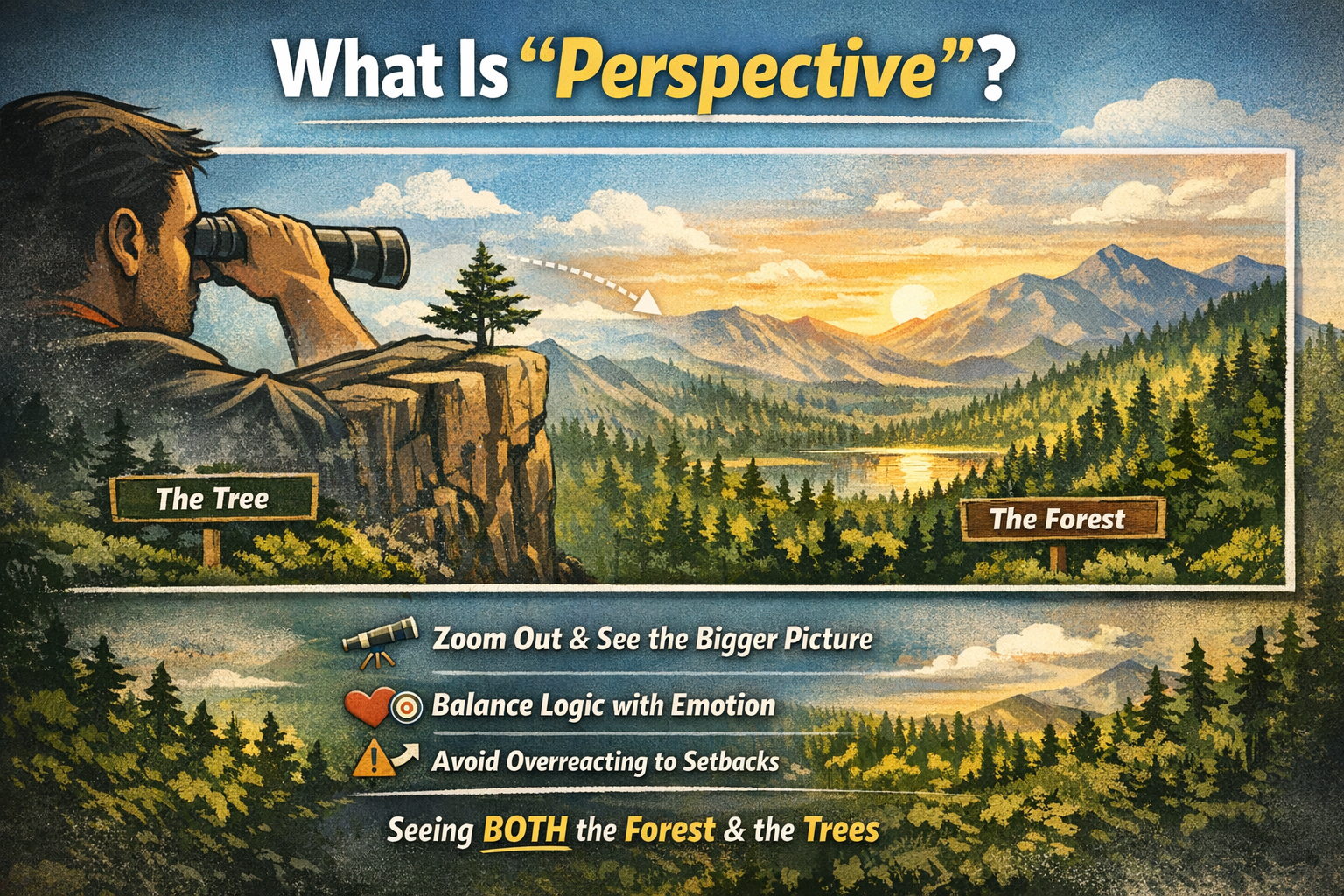
Perspective is your ability to step back and see a situation in context. Not just what’s happening right now, but how it fits into the bigger picture of your life, goals, and health.
At its core, perspective allows you to:
- Zoom out from the moment
- Separate short-term emotion from long-term direction
- Avoid overreacting to temporary setbacks
In practical terms, perspective means seeing both the forest and the trees. You can acknowledge stress, discomfort, or frustration without letting it define the entire story.
From a mental health standpoint, perspective is a foundational skill. It’s closely tied to perspective-taking, which is intentionally taught in therapies like CBT and ACT to help people:
- Reframe anxious or catastrophic thoughts
- Reduce rumination and emotional reactivity
- Respond with intention instead of impulse
Perspective also counters our natural negativity bias, the brain’s tendency to fixate on threats and mistakes. Without it, one bad day feels like failure. With it, that same day becomes information.
In short:
- Perception is what feels true in the moment
- Perspective is what stays true over time
That distinction is where resilience begins. |
| | | |
| | | |
| | |
| The Brain and Body on Perspective
Perspective isn’t just a mindset shift. It creates measurable changes in the brain and body.
In the brain:
- Reframing a situation (called cognitive reappraisal) activates the prefrontal cortex, the area responsible for reasoning, regulation, and decision-making
- This helps downshift emotional reactivity coming from the amygdala, the brain’s threat center
- Perspective-taking also engages regions tied to empathy and higher-order thinking, allowing us to pause before reacting
- With repetition, these neural pathways strengthen, making calm, regulated responses more automatic over time
In simple terms, perspective gives the brain a brake pedal. Without it, emotion drives. With it, intention leads.
In the body:
- Perspective-shifting experiences, especially those involving awe, trigger a parasympathetic response
- This shows up as increased vagal tone, which supports recovery, digestion, and emotional regulation
- Stress hormones decrease, while oxytocin increases, creating a sense of safety and connection
- Inflammatory markers drop, signaling a shift away from chronic stress and toward healing
Research has even shown that reframing major stressors with a growth-oriented perspective leads to:
- Lower long-term depression
- Reduced inflammation months later
- Improved emotional resilience under sustained stress
The takeaway is simple.
When perspective widens, the nervous system settles.
When the nervous system settles, both mental clarity and physical recovery improve.
Perspective doesn’t eliminate stress. It changes how the body carries it. |
| | | |
| | | |
| | | |
| | |
| Perspective by the Numbers
26%
In one study, only about a quarter of people actively try to “get” someone else’s perspective on issues. However, those who did made more accurate predictions and better decisions. (Most of us overestimate our own objectivity!)
Reduced Depression
Participants in a Stanford study who were guided to view the pandemic as an opportunity for growth reported significantly less depression and showed lower inflammation markers three months later compared to a control group.
Awe Boosts Creativity
A lab experiment found that inducing awe significantly improved creative problem-solving. Subjects who felt awe generated more ideas and thought more flexibly than those in a neutral or amusing condition.
Awe Heals
In controlled research, people experiencing awe (versus other positive emotions) had higher vagal tone and lower stress chemistry, traits linked to better heart health and immunity.
Kids Learn Perspective
Even young children benefit: after a 10-week empathy training, preschoolers showed significantly better perspective-taking skills than peers, and the gains persisted a month later.
Mindset Matters
In an educational setting, combining a growth mindset with a stress-is-enhancing mindset decreased students’ daily cortisol (stress hormone) and improved their grades in challenging courses (vs. standard instruction) (The lesson: how we interpret stress and setbacks affects both body and performance.) |
| | | |
| | | |
| | |
| Tiger Resilience Lens: Perspective vs. Perception
We often confuse perspective with perception, but for resilience they play different roles. Perspective is like zooming out to see long-term patterns; perception is our immediate, often biased, view. Consider these contrasts:
|
Dimension
|
Perspective
|
Perception
|
|
Mind
|
Big-picture, context-driven thinking; considers lessons from past and values
|
Narrow focus on the here-and-now; quick judgments and assumptions
|
|
Body
|
Long-term wellness view (training journey, recovery cycles)
|
Immediate reactions (stopping at pain, chasing quick fixes)
|
|
Emotion
|
Calmer, understands where feelings come from; sees ups and downs as normal
|
Reactive swings; driven by the “loudest” emotion in the moment
|
|
Behavior
|
Intentional habits aligned with values; chooses actions based on goals
|
Impulsive or habitual responses to situations (“auto-pilot” mode)
|
|
Performance
|
Focus on steady improvement (your own progress) and growth mindset
|
Focus on immediate outcomes or comparisons (win/lose, success/failure)
|
|
Long-Term
|
Builds lasting change and identity; resilient in face of setbacks
|
Susceptible to burnout or giving up when short-term results stall
|
Perspective in action: A graduate student keeps training week after week (perspective) vs. obsessing over one bad exam grade (perception). The student who maintains perspective learns from the exam and adjusts study habits, whereas the other might spiral into discouragement. Perspective is the long game; perception is the here-and-now. |
| | | |
| | | |
| | |
| Michael’s Training Corner: Perspective in Fitness
In training, perspective means measuring progress against your own baseline, not someone else’s highlight reel or an old version of yourself that had different priorities.
This is where a lot of people get stuck.
They train consistently, but they judge progress with the wrong lens.
Perspective in training starts with understanding context:
- What phase of training you’re in
- What you’re prioritizing right now
- What you’ve traded off to pursue that goal
If your current focus is endurance, aerobic development, or sport-specific performance, you have to accept that:
- You may not be as big or as strong as when hypertrophy or max strength was the goal
- That doesn’t mean you’re losing progress, it means progress is showing up somewhere else
That shift alone prevents a lot of unnecessary frustration.
Where perspective really shows up in fitness:
- Can you handle more total training volume than before?
- Do workouts feel more controlled at the same pace or weight?
- Is recovery faster between sessions?
- Does effort feel different, even if numbers look similar?
This is where Rate of Perceived Exertion (RPE) becomes useful.
RPE isn’t about how hard something “should” feel.
It’s about how hard it feels to you.
For example:
- A run that used to feel like an 8 out of 10 now feels like a 6
- The same squat load feels stable instead of shaky
- A lift or interval you once dreaded now feels manageable
Nothing on paper changed.
Your capacity did.
That’s perspective in action.
How to apply this practically:
- Track effort, not just outcomes. Write down RPE alongside pace, weight, or distance.
- Compare against yourself from 8–12 weeks ago, not last year or someone else.
- Zoom out your timeframe. Ask, “Is this building toward where I want to be in 6–12 months?”
- Celebrate consistency first. Showing up matters more than perfect sessions.
- On low-energy days, do something. Keeping the habit alive preserves momentum.
One personal note.
My current priority is being the best runner I can be and seeing how far I can push that. That means I’ve accepted I won’t look or lift the way I did when strength and hypertrophy were my main focus. That’s not a loss. It’s clarity.
Perspective lets you commit fully without second-guessing the trade-offs.
When training lacks perspective, people chase everything and progress nowhere.
When perspective is clear, effort becomes calmer, smarter, and sustainable.
That’s how real progress sticks. |
| | | |
| | | |
| | | |
| | |
| Real-World Spotlight: Dr. Alia Crum on Perspective and Performance
Stanford psychologist Alia Crum has spent years translating the idea of perspective into something measurable and actionable. Her work focuses on mindset interventions. Small shifts in how people interpret stress, effort, and challenge.
We’ve referenced Crum’s research before, particularly when we spotlighted Andrew Huberman in a past newsletter on nervous system regulation. Her work consistently shows up where psychology, physiology, and performance intersect.
What Crum’s research shows:
- Stress isn’t inherently harmful. How we interpret stress matters more than its presence.
- When people reframe adversity as meaningful or growth-oriented, outcomes improve.
- Perspective shifts can lead to:
- Lower levels of depression
- Reduced inflammatory markers
- Greater resilience under prolonged stress
- These changes persist months later, not just in the moment.
One of her most compelling findings came from research during the COVID-19 pandemic. Participants who were guided to view the crisis not only as a disruption, but also as a context for growth, showed better mental and physical health outcomes compared to those who didn’t adopt that perspective.
The takeaway is simple but powerful:
- Events don’t define outcomes.
- Interpretation drives adaptation.
This doesn’t mean pretending hard things aren’t hard. It means choosing a frame that allows your nervous system to stay regulated while you continue to move forward.
If you want a deeper breakdown of how mindset, stress, and physiology interact, we highly recommend watching Dr. Crum’s recent conversation with Andrew Huberman.
🎥 Watch here:
https://www.youtube.com/watch?v=alVWRl_X_AA |
| | | |
| | | |
| | | |
| | |
| 📝 Interactive Journal: Perspective in Action
Spend 5–10 minutes with these prompts. The goal is clarity, not perfection. Journal your answers and observations.
- Identify a Challenge: Write down a current goal or stressor you’re facing. Describe it plainly.
- Reframe It: Now list three different ways to view this situation. (For example: as a learning opportunity, as a temporary hurdle, as a chance to build a new skill, etc.) Go beyond your first instinct, imagine a long-term or creative angle.
- Spot the Bias: What’s one negative assumption or fixed belief you have about this situation? Write it out, then flip it. (E.g. “I’m a failure because I missed a workout” → “Everyone slips sometimes; progress is about consistency, not perfection.”)
- Daily Perspective Shift: For the next 7 days, commit to one daily action that broadens your view. This could be taking a 5-minute nature break, noticing something you’re grateful for at morning, or trying to see a problem from a friend’s point of view. Record what you did each day.
- Reflection Journal: Each day, note any small changes you notice, in mood, energy, or ideas. At the end of the week, review: Did thinking differently change anything? Even subtle shifts (feeling calmer, seeing a new solution, feeling inspired) are signs it’s working.
For deeper practice, try perspective meditation: Spend a few minutes imagining yourself in the future, looking back at today’s challenges with 10x hindsight. What would “future you” advise?
For more structured prompts, daily reflection space, and guided exercises to build confidence and consistency, explore the journal that pairs with our resilience work.
👉 Awaken the Tiger and Phoenix Self-Esteem Journal
https://www.amazon.com/Awaken-Tiger-Phoenix-build-Esteem/dp/B0DBRWTGS9 |
| | | |
| | | |
| | |
| Final Thoughts: Perspective and the 5 Pillars
When viewed through our Tiger Resilience framework, perspective becomes an operational mindset:
- Purpose: Perspective gives your purpose traction. By linking daily actions to a greater “why,” every small step gains meaning. For instance, remembering why you train (e.g. to stay healthy for your family) keeps workouts from feeling pointless. A broad purpose-oriented perspective makes daily tasks feel aligned with values.
- Planning: Perspective keeps planning realistic and flexible. Instead of rigid timelines, you create plans that allow adjustments. For example, knowing that “progress isn’t linear,” you build in recovery periods and milestone check-ins. Long-term perspective prevents the trap of all-or-nothing planning (e.g. “If I can’t do it perfectly today, might as well quit”) and favors adaptable strategies.
- Practice: Perspective lives in practice. Showing up consistently (even on low days) becomes its own win when you value long-term growth. Perspective helps you treat each workout or study session as a piece of a larger puzzle. You’re practicing perspective-taking itself: learning to step back and observe your habits objectively.
- Perseverance: Perspective fuels perseverance. When results stall or motivation dips, a broad perspective reminds you that setbacks are temporary and part of the journey. It’s perseverance, not frantic effort, that compounds. If you keep the faith that small actions will pay off, you’re less likely to burn out or quit early.
- Providence: Perspective cultivates humility and trust. It acknowledges the role of factors beyond your control (genetics, other people, random events) without giving up. This balanced view prevents frustration when things don’t go exactly as planned. It invites the idea that timing, serendipity, and “the right moment” play a role – so you stay patient and ready when opportunity comes.
In sum, perspective isn’t about ignoring reality, it’s about choosing the frame. By doing the work to see challenges from multiple angles, you turn even “ordinary” days into stepping stones. Over time, what felt small or mundane becomes the foundation of something extraordinary. Keep perspective in your toolkit, and one day you’ll look back and see how those quiet shifts changed everything.
Stay Resilient,
Tiger Resilience
📚 References
Aslan, D., & Köksal Akyol, A. (2020). Impact of an empathy training program on children’s perspective-taking abilities. Psychological Reports, 123(6), 2394–2409.
https://doi.org/10.1177/0033294119868785
https://pubmed.ncbi.nlm.nih.gov/31591822/
Chirico, A., Gaggioli, A., Pezzi, L., & Riva, G. (2018). Awe enhances creative thinking: An experimental study. Creativity Research Journal, 30(2), 123–131.
https://doi.org/10.1080/10400419.2018.1446491
Crum, A. L., Akinola, M., Martin, A., & Fath, S. (2017). The role of stress mindset in shaping cognitive, emotional, and physiological responses to challenging and threatening stress. Anxiety, Stress, & Coping, 30(4), 379–395.
https://doi.org/10.1080/10615806.2016.1275585
Crum, A. L. (2025, August 26). Study shows mindset shift curbs depression after catastrophe. Stanford News.
https://news.stanford.edu/stories/2025/08/mindset-intervention-catastrophe-covid-19-mental-health-depression-inflammation
Damen, D., Pollmann, M. M. H., & Grassow, T.-L. (2021). The benefits and obstacles to perspective getting. Frontiers in Communication, 6, Article 611187.
https://doi.org/10.3389/fcomm.2021.611187
https://www.frontiersin.org/articles/10.3389/fcomm.2021.611187/full
Gross, J. J. (2015). Emotion regulation: Current status and future prospects. Psychological Inquiry, 26(1), 1–26.
https://doi.org/10.1080/1047840X.2014.940781
Hayes, S. C., Strosahl, K. D., & Wilson, K. G. (2012). Acceptance and commitment therapy: The process and practice of mindful change (2nd ed.). Guilford Press.
Monk, S. (2021, May). The strength of perspective. The Positive Psychology People.
https://www.thepositivepsychologypeople.com/the-strength-of-perspective/
Monroy, M., & Keltner, D. (2023). Awe as a pathway to mental and physical health. Perspectives on Psychological Science, 18(2), 309–320.
https://doi.org/10.1177/17456916221094856
https://pmc.ncbi.nlm.nih.gov/articles/PMC10021107/
Paulson, K. (2020, August). A little awe goes a long way. Medium.
https://katrinapaulson.medium.com/a-little-awe-goes-a-long-way-07e0749b4176
Rutberg, J. (2025, March 7). RPE: How to use rating of perceived exertion in training and racing. CTS Training.
https://trainright.com/rpe-rating-of-perceived-exertion-in-training-and-racing/
Huberman, A. (2024, September). Dr. Alia Crum: Stress, mindset, and performance. Huberman Lab Podcast.
https://www.youtube.com/watch?v=alVWRl_X_AA
|
| | | |
|