|
| |
| |
| | |
|
Synthesis: For You to Create
|
| | | |
| | |
| Welcome to Our Latest Newsletter!
📚 Read Time: 8 Minutes
Synthesis is the ability to take what’s scattered, fragmented, or incomplete, and create something whole. It’s not just a scientific term or a creative buzzword. It’s a mindset. One that allows you to draw connections where others see chaos, to turn raw experience into meaning, and to weave together your values, habits, and purpose into something that lasts.
In training, it’s how your body builds back stronger. In thought, it’s how ideas evolve into insight. In life, it’s how you take everything you’ve lived through, the good, the painful, the uncertain, and shape it into something coherent, something you.
This week, we’re breaking down synthesis not just as a process, but as a power: how it works in the brain and body, how it strengthens identity and creativity, how it contrasts with analysis, and how you can harness it in your training, your mindset, and your self-leadership.
🔗 Want to revisit past editions or share with someone who could use this?
Check out the full Tiger Resilience archive and share to sign up for future newsletters here:
👉 Explore the Tiger Resilience Newsletter Library |
| | | |
| | |
| 🧭 What Is Synthesis?
Synthesis is the process of combining separate parts to create a unified whole. It’s how nature builds complexity, how the brain creates meaning, and how we evolve through experience. In a fragmented world, synthesis is what makes us whole again.
Here’s how it plays out across domains:
- 🧪 Scientifically: In biology and chemistry, synthesis refers to building something new from simpler elements, like amino acids forming proteins or molecules bonding to create a compound. It’s the literal act of construction in life itself.
- 🧠 Cognitively: In psychology and education, synthesis is when your brain connects different ideas, experiences, or disciplines to generate insight. It’s the root of creative thinking. You’re not just memorizing facts; you’re combining them to form something original.
- 💬 Emotionally: Synthesis means integrating your thoughts, emotions, and past experiences into a coherent personal narrative. This is key to mental health. When we make sense of our story, even the painful parts, we stop feeling fragmented and start becoming whole.
- 🌱 Holistically: True resilience comes when the mind, body, heart, and spirit work in harmony. Synthesis is the glue that links those dimensions. Without it, we live in parts. With it, we move as one integrated force.
Synthesis isn’t about perfection. It’s about integration. Taking what you’ve lived, learned, and lost, and building something meaningful with it. |
| | | |
| | |
| Michael’s Perspective: The Art of Synthesis
When I first hear the word synthesis, my mind immediately goes to science, to chemistry, physiology, and the tangible mechanics of how the body transforms effort into growth. But the more I’ve lived, trained, coached, and reflected, the more I realize that synthesis isn’t just biological, it’s existential. It’s the way we combine pieces of ourselves into something stronger, something whole.
Every meaningful change, in fitness, work, or life, is an act of synthesis. You take input, stress, failure, knowledge, and you build. That’s the hidden architecture of growth.
In training, this happens literally every time you lift a weight, finish a hard run, or push through the edges of fatigue. You break down. Your body responds by rebuilding stronger, muscle protein synthesis in action. But that same process exists in your mind. Every time you adapt to stress instead of avoiding it, you’re synthesizing new patterns of control, focus, and resilience. It’s the same principle, only now the muscle is psychological.
The people who grow the most, in the gym or in life, are the ones who learn how to synthesize chaos into order. They don’t just endure stress; they translate it. They take the breakdowns, the missed lifts, the failed races, the quiet doubts, and they convert them into lessons, strategy, perspective, and power.
That’s what I love about this word. It’s the bridge between science and spirit.
If you were to take your ability to do or create anything, you have to synthesize it first, mentally, emotionally, physically, before it ever becomes real. You can’t build what you haven’t first assembled in thought and action.
When stress or fatigue hit, most people crumble because the goal feels too far away. The distance between “here” and “there” feels impossible to close. The brain starts negotiating: “Maybe this isn’t worth it. Maybe I’m not cut out for it.”
That’s where the art of synthesis shows up again, because the best athletes and creators in the world don’t eliminate difficulty; they restructure it.
They shrink the distance. They move the goalpost.
You don’t have to run the entire race, you just have to reach the next turn. You don’t have to write the whole book, just the next paragraph. You don’t have to rebuild your whole life, just get through this one day with integrity.
Each small act compounds. Each small success becomes the raw material for something greater.
That’s what synthesis looks like in real time, the ongoing combination of small wins, steady effort, and emotional regulation. It’s how your brain learns to associate effort with possibility rather than exhaustion.
When you practice synthesis, you stop chasing perfection and start creating momentum. You stop waiting for ideal conditions and start assembling progress from what’s in front of you.
That’s the same mindset that drives adaptation in the body, you expose it to stress, you recover, and you build. Every rep, every step, every meal is a vote for your future self.
So if you’re in the middle of a long process right now, training, building, healing, remember this: your job isn’t to see the whole path. It’s to synthesize the next step. To take what’s raw and uncertain and make it slightly more refined, slightly more yours.
Keep combining effort with meaning. Data with intuition. Stress with recovery.
Because that’s where transformation happen, not in the grind alone, but in the synthesis of everything you’re becoming. |
| | | |
| | |
| Bernie’s Perspective: The Alchemy of Growth
There’s a quiet moment after every storm, the noise fades, the dust settles, and you finally see what’s been built in the chaos. That moment is called synthesis.
Synthesis is where the lessons of your past stop competing for your attention and start collaborating for your evolution. It’s the art of weaving everything you’ve lived, the heartbreaks, the hard work, the victories, and the failures, into something meaningful. It’s not about rewriting your story; it’s about recognizing how every chapter has prepared you for this one.
I like to imagine these experiences as a quilt, each patch a stage of your journey, stitched together by the trials and triumphs that shaped you. When I lay out my own quilt, I see patches of every size and color, some intertwined, some separated by years, but all essential to the pattern of my life.
Tiger Resilience, as it stands today, is the culmination of so many of these patches. Before my father passed away, I was a child fascinated by two things: music and science. At six or seven, I saw myself as both an astronaut exploring distant planets and a musician lighting up a stage. Music, especially, became a thread running through my life, even in my most challenging times. After being homeless as a teenager, my first real income came from playing in a band, followed by a career in business by day. Those patches, music and business, might seem like odd fits, but together they taught me about collaboration, discipline, and creativity. The skills I learned on stage translated seamlessly to working with professionals in the business world.
A few years later, my path shifted again, this time into behavioral health, where I taught special needs students on Cape Cod. My education wasn’t in developmental disabilities or behavioral health, but every prior experience prepared me for this chapter. The truth? I didn’t finish college until years later, after I’d already found my niche and my voice in the field.
That voice would carry me through managing hospital settings, including inpatient and outpatient programs, as well as counseling roles. Each new patch, clinical skills, personal development, business, music, became part of a vibrant, eclectic quilt. What looked like a hodgepodge at first glance turned out to be the foundation of Tiger Resilience.
Looking back, the design makes perfect sense. If I’d set out to build a well-rounded, balanced set of skills, I couldn’t have planned a better trajectory. Every patch, every detour, was necessary.
At the heart of Tiger Resilience is a simple yet profound belief: everyone has the ability to reach their full potential and discover their own unique voice. Our Five Pillars, Purpose, Planning, Practice, Perseverance, and Providence, are the threads that tie together the human experience: body, mind, heart, and spirit.
That’s the beauty of synthesis, it turns scars into structure, endurance into insight. The Tiger gathers what was scattered; the Phoenix refines what remains. Together, they remind us that nothing is wasted. Every setback carries a seed of wisdom. Every trial builds a tool for the journey ahead.
You don’t need a new life to begin again, you need to see how your old one has been preparing you for this moment all along.
This is the alchemy of growth: where resilience becomes wisdom, and strength becomes wholeness.
Resilience, at its core, isn’t about bouncing back, it’s about becoming whole.
You’ve already lived the lessons. Now it’s time to live the wisdom they left behind. |
| | | |
| | | |
| | |
| 🧠🩺 The Science of Synthesis: Brain & Body
Synthesis isn’t abstract. It’s something your brain and body do constantly, every time you make sense of an experience, recover from a challenge, or connect the dots between thought and action. Let’s break it down.
🧠 In the Brain
- Your brain is a master integrator. Right now, it’s blending sensory input, emotional signals, and memory into one coherent experience. That’s synthesis in action.
- The hippocampus binds together elements of memory (people, places, feelings) so you can recall full experiences, not isolated fragments.
- The prefrontal cortex connects logic with emotion. This allows you to regulate impulses, make thoughtful decisions, and link short-term choices to long-term values.
- Creativity? That’s synthesis too. Your brain subconsciously tests combinations of past experiences and ideas, then suddenly, something clicks. Insight emerges when fragments become form.
🧠🧘 Emotional Integration
- Emotional synthesis is how we make sense of what we feel, especially after stress or trauma.
- When your emotional centers (like the amygdala) are in sync with your higher thinking areas, you can name, reframe, and regulate what’s happening inside. That’s what helps you stay composed under pressure.
- Without synthesis, emotions get stuck. You suppress, deny, or explode. But when you integrate, through reflection, journaling, or therapy, those emotions become part of your story, not the thing that controls it.
🦾 In the Body
- Biologically, synthesis drives growth. After a workout, your body enters anabolism, a building state. Muscle fibers torn from effort begin repairing and growing stronger through muscle protein synthesis (we’ll break that down in Michael’s Training Corner).
- Your nervous system also learns through integration. When you expose yourself to challenge, intentionally and consistently, your body adapts. Stress responses become more measured. Heart rate variability improves. You don’t just toughen up, you recalibrate.
- Practices like breathwork, movement, and mindfulness all promote systemic synthesis: calming the nervous system while activating focus, awareness, and emotional regulation in tandem.
🧩 Takeaway
Synthesis is what allows your systems to talk to each other. It’s why your brain doesn’t freeze under stress, why your muscles grow after strain, and why your nervous system knows the difference between danger and challenge. It’s the coordination beneath composure. The integration beneath strength. |
| | | |
| | | |
| | | |
| | |
| 📊 Stats Worth Knowing: The Power of Synthesis
Synthesis isn’t just a concept, it has measurable, research-backed benefits that show up across learning, longevity, performance, and personal growth. These stats reveal how integrating parts into a cohesive whole gives you a powerful edge.
🧠 Learning & Cognitive Health
- Interdisciplinary learning (synthesizing across subjects) boosts retention, engagement, and problem-solving. Students learn better when ideas are connected. not siloed.
- A 10-year study of older adults showed those who regularly learned new skills had ~11% lower risk of dementia than peers who didn’t. Integration keeps the brain sharp.
💡 Creativity & Innovation
- Nobel Prize–winning scientists are nearly 3× more likely to have artistic hobbies than their peers. Creative synthesis. linking unrelated domains. fuels breakthrough thinking.
- Teams that integrate diverse perspectives solve problems ~30% faster than homogenous groups. Synthesis across minds is just as powerful as synthesis within one.
- Mixed-gender teams generate 41% more innovative ideas, showing that combining different viewpoints creates better outcomes than uniformity.
🧬 Health, Purpose & Longevity
- A large-scale study found that adults with a strong sense of life purpose had significantly lower mortality and reduced cardiovascular risk. Why? Purpose synthesizes values, goals, and actions into one guiding direction.
- Mind-body practices that encourage integration (like mindfulness or breathwork) improve heart rate variability, a marker of nervous system health and resilience.
- Fragmented stress, where emotions, thoughts, and actions are out of sync, leads to higher allostatic load (wear and tear on the body). Integration lowers it.
🧩 Takeaway
The data is clear: people who synthesize, who connect ideas, experiences, emotions, and disciplines, learn faster, create more, solve problems better, and even live longer. In a world built for specialization, synthesis is your competitive advantage. |
| | | |
| | | |
| | |
| 🐅 Tiger Resilience Lens: Synthesis vs. Analysis
Analysis and synthesis are two sides of mastery. One breaks things down to understand. The other puts things together to create. Both are essential, but they serve different purposes in the pursuit of growth.
Analysis dissects. It asks: What are the parts? What’s wrong? Where do we isolate the problem?
Synthesis connects. It asks: How do the pieces relate? What’s the bigger pattern? What can we build from this?
In the Tiger Resilience model, both show up across the Four Domains of the Human Condition:
|
Domain
|
Analysis (Breakdown)
|
Synthesis (Integration)
|
|
Body
|
Identifies weaknesses, isolates muscle groups, parses injuries.
|
Combines systems, strength, mobility, recovery, for holistic performance.
|
|
Mind
|
Focuses on logic, critical thinking, and error detection.
|
Links ideas, forms insights, builds wisdom through connection.
|
|
Heart
|
Labels emotions, recognizes patterns of reactivity.
|
Blends feelings into coherent self-understanding and balanced response.
|
|
Spirit
|
Questions beliefs, challenges assumptions, separates truth from habit.
|
Aligns actions with purpose, connects to something bigger than self.
|
🔍 Why the Balance Matters
- Too much analysis leads to fragmentation: all parts, no picture.
- Too much synthesis can drift into abstraction: all picture, no precision.
Resilience comes from knowing when to analyze (clarity, correction) and when to synthesize (connection, creation).
Analysis is what helps you spot the weak link in a chain.
Synthesis is what helps you build a bridge out of broken pieces.
Both require intention. Both can be trained. But only synthesis can give meaning to what analysis uncovers. That’s what turns knowledge into wisdom, training into growth, and experience into transformation. |
| | | |
| | | |
| | |
| 🏋️ Michael’s Training Corner: Building Muscle Through Synthesis
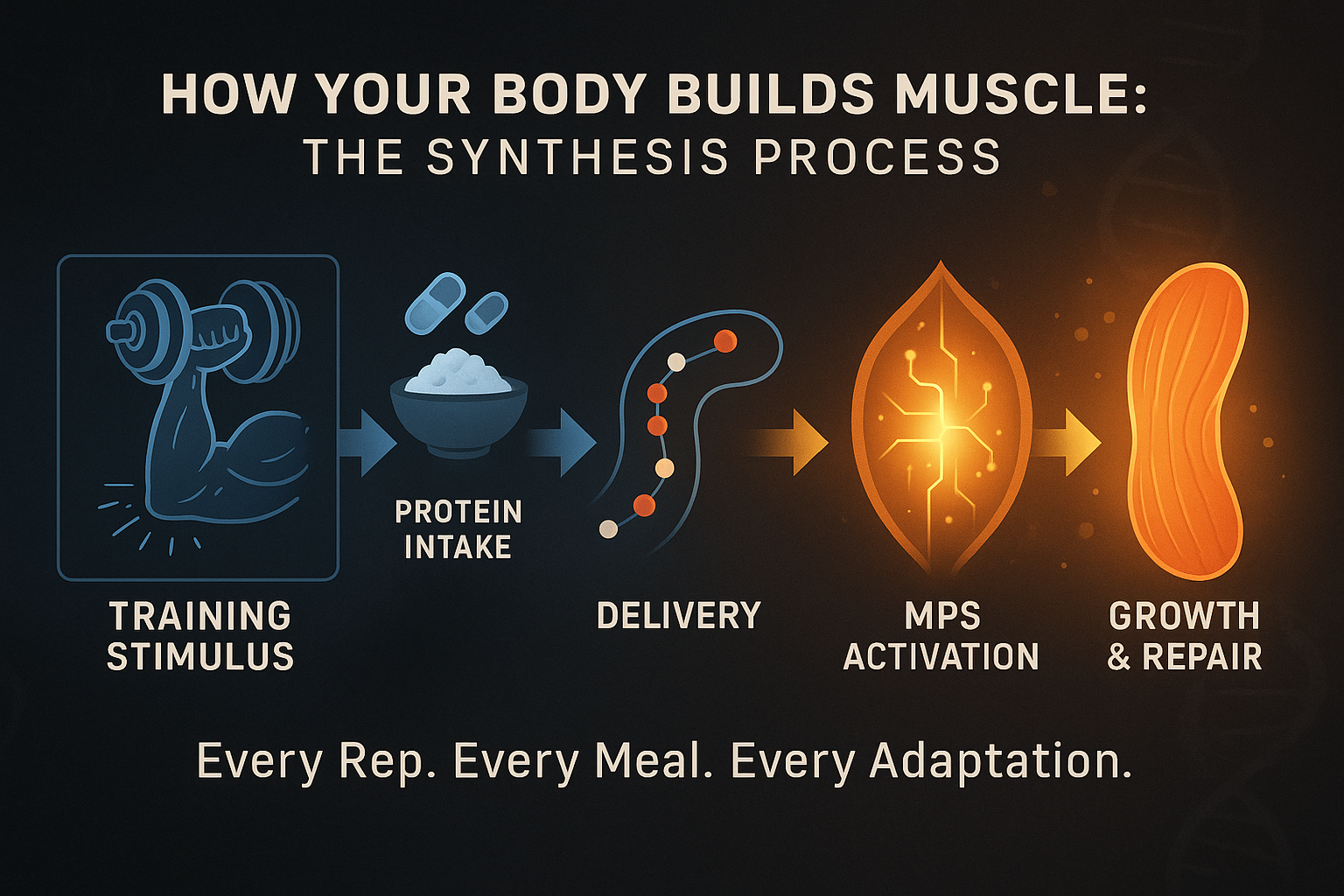
If you’ve ever trained hard and wondered how your body actually builds muscle, this is it. Muscle Protein Synthesis (MPS) is the literal act of construction. It’s your body taking amino acids from the protein you eat and turning them into new muscle tissue. Every gain you’ve ever made came from this process.
Part 1: What Is Muscle Protein Synthesis?
Muscle growth isn’t magic. It’s a biological synthesis process, your body fuses together building blocks (amino acids) to repair and reinforce your muscle fibers after training stress.
Here’s the flow:
1. You train (preferably intense and smart).
2. Muscle fibers break down, microtears signal the need for repair.
3. You eat protein.
4. Amino acids enter the bloodstream and get shuttled into muscle cells.
5. Your body initiates MPS, new proteins are built, old ones replaced, and muscle structure upgraded.
MPS is literally how you adapt. No MPS, no growth. And if breakdown exceeds synthesis over time, you lose mass and strength. This process is always in flux, so what you do (and eat) daily matters.
Part 2: Optimal Dosing — How Much Protein Stimulates Growth?
There’s a threshold, and it’s surprisingly manageable:
- ~10 grams of essential amino acids (EAAs) reliably stimulate MPS.
- That’s roughly 20–30g of high-quality protein per meal, depending on your age, training load, and goals.
Younger adults can often stimulate MPS with 20g.
Older adults (due to anabolic resistance) typically need 30g+ to get the same effect.
Leucine, one of the EAAs, is the key trigger, think of it as flipping the “build” switch. Animal proteins (whey, meat, eggs) and well-combined plant proteins (soy, rice + beans, pea blends) can all meet this threshold if dosed properly.
👉 Takeaway: Aim for 3–4 protein-rich meals per day, spaced every ~4 hours. Each should hit the 20–30g mark to keep MPS activated throughout the day.
Part 3: Daily Intake — How Much Protein Do You Really Need?
Forget the outdated government RDA of 0.8 g/kg bodyweight, that’s just the minimum to prevent deficiency, not optimize performance or health.
Here’s what the research actually supports:
- 1.6–2.2 g/kg of bodyweight per day is the evidence-based range for maximizing muscle gain and repair.
- For a 75 kg (165 lb) person, that’s about 120–165g of protein daily.
This aligns with what top researchers and elite coaches have observed for years. An approachable intake that also doesn't reflect the extreme suggestions by bodybuilders, fitness influencers, etc.
And no, that intake isn’t dangerous for healthy kidneys. Meta-analyses confirm it’s safe, sustainable, and effective for active individuals.
Part 4: Strategic Protein = Smarter Recovery
Think of protein like fuel, but also like bricks. You don’t need to dump it all at once. Consider trying to dose it consistently (albeit total daily intake is most important), especially post-training when your muscles are primed to absorb it.
Example daily distribution:
- Breakfast: 25g (e.g. eggs + Greek yogurt)
- Lunch: 30g (e.g. chicken, tofu, lentils)
- Snack: 20g (e.g. shake or bar)
- Dinner: 35g (e.g. fish, tempeh, steak)
That’s how you keep your MPS running, not just triggered once, but optimized all day long. |
| | | |
| | | |
| | | |
| | |
| 🌍 Real-World Spotlight: Steve Jobs — Creative Synthesis in Motion
When it comes to synthesis as a force for creation, few embodied it more profoundly than Steve Jobs. To him, synthesis wasn’t just a skill, it was a philosophy.
“Creativity is just connecting things. When you ask creative people how they did something, they feel a little guilty because they didn’t really do it, they just saw something. It seemed obvious to them after a while.” – Steve Jobs
Jobs believed the most powerful ideas emerge at the intersection of disciplines: technology and art, logic and emotion, design and function. His life’s work was proof that integrating opposites creates breakthroughs.
🔧 The Apple Mindset
- Jobs famously took a calligraphy course as a college dropout, and years later, used what he learned to design the Mac’s beautiful typography. That’s synthesis: pulling from unrelated experiences to shape innovation.
- He fused aesthetics with engineering in a way the tech world had never seen. Apple didn’t just build products, they built experiences.
- His leadership pushed teams to unite hardware, software, and user design into one seamless ecosystem. The iPod, iPhone, and Mac weren’t just functional. They were integrated. Intuitive. Whole.
💡 Why He Matters to This Theme
Steve Jobs didn’t invent synthesis, but he lived it. He understood that when you stop treating life, skills, and knowledge as separate compartments… you start building things no one else can.
His work reminds us:
- Don’t just specialize — connect.
- Don’t just execute — integrate.
- Don’t just analyze — synthesize.
Whether you’re building a product, a training plan, or a new version of yourself, what you combine matters more than what you start with. |
| | | |
| | | |
| | | |
| | |
| 📝 Journal Exercise: From Fragments to Wholeness
Synthesis starts with awareness. You can’t integrate what you haven’t acknowledged. This week’s reflection is about taking the pieces of your life that feel disconnected, and weaving them into something intentional.
Before you begin, slow your breathing for a few minutes. Let your nervous system settle. Clarity follows calm.
Part 1: Spot the Fragmentation
- Where in my life do I feel divided or pulled in different directions?
- Are there parts of myself I’ve been ignoring, hiding, or suppressing?
- What roles or responsibilities feel at odds with each other (e.g. parent vs. professional, leader vs. learner)?
Write freely, don’t edit. Just let the inner noise land on paper.
Part 2: Imagine Integration
- What would it feel like if these pieces worked together instead of apart?
- How might one part of me support the other, rather than compete?
- Can I reframe this inner tension as a strength? (e.g. “My discipline fuels my creativity,” or “My vulnerability deepens my leadership.”)
Bonus prompt: Write a short letter or dialogue between two sides of yourself that often conflict. Let them speak honestly. Then, help them meet in the middle.
Part 3: Take One Integrative Action
- What’s one small act I can do this week that honors my whole self?
- (Examples: schedule 30 minutes for a neglected passion, have an honest conversation, bring mindfulness into your training.)
- How can I reinforce the belief that I don’t need to “choose a side”, I can be a both/and person?
Affirmation:
“I am not one thing. I am many things, working together. I honor all parts of me. I am a whole, evolving self.”
🔗 For deeper prompts and daily reflection tools that help you integrate confidence, discipline, and emotional strength, explore the Awaken the Tiger and Phoenix Self-Esteem Journal – now available on Amazon:
👉Awaken the Tiger and Phoenix Self-Esteem Journal |
| | | |
| | | |
| | |
| 🔥 Final Thoughts: The Five Pillars and Synthesis
Synthesis is the thread that turns fragments into function. It’s not just a skill, it’s a way of living with intention, where every part of you works in alignment.
In the Tiger Resilience model, the Five Pillars create the structure for sustainable growth. Synthesis is what binds them together. Without it, the pillars stand alone. With it, they form a strong, integrated whole.
🧭 Purpose – Direction Through Integration
Purpose isn’t something you stumble on, it’s something you build. And you build it by synthesizing your passions, values, experiences, and beliefs into a clear “why.” When your choices reflect your inner compass, your life stops feeling random and starts feeling aligned.
🗺️ Planning – Clarity Through Connection
A solid plan isn’t just about tasks. It’s about connecting your daily actions to long-term meaning. Planning with synthesis means designing a life where your time, energy, and attention support the person you’re becoming, not just the boxes you’re checking.
🛠️ Practice – Integration Through Repetition
Every time you repeat a skill, a breathwork drill, a mindset shift, you’re not just doing, you’re wiring. Synthesis is what helps practice move beyond routine into identity. It’s how you go from “I do this” to “This is who I am.”
🐅 Perseverance – Staying Whole Under Pressure
Stress fragments us. Synthesis is what helps us hold the pieces together. When discomfort hits, it’s not just willpower that keeps you grounded, it’s the ability to link pain to purpose, fatigue to growth, and effort to identity. That’s how you persevere without losing yourself.
🙏 Providence – Trusting the Bigger Picture
Not everything makes sense right away. But synthesis reminds us that meaning can emerge over time. When you trust that even the disconnected pieces of your story belong, you stop resisting the unknown and start participating in a larger, more connected journey.
Synthesis is what turns experience into wisdom.
It’s what lets you lead yourself when nothing feels clear.
It’s how you become whole, not by eliminating your contradictions, but by integrating them into something stronger.
This week, step back and look at your life not as scattered tasks or disconnected goals, but as a living system. A design. A message.
One only you can create.
Stay curious, stay connected, and as always… Stay Resilient.
Until next time,
Bernie & Michael
Tiger Resilience
📚 References
Atherton, P. J., Smith, K., Etheridge, T., Rankin, D., & Rennie, M. J. (2010). Distinct anabolic signalling responses to amino acids in C2C12 skeletal muscle cells. Amino Acids, 38(5), 1533–1539. https://doi.org/10.1007/s00726-009-0377-x
Areta, J. L., Burke, L. M., Ross, M. L., Camera, D. M., West, D. W. D., Broad, E. M., ... & Coffey, V. G. (2013). Timing and distribution of protein ingestion during prolonged recovery from resistance exercise alters myofibrillar protein synthesis. The Journal of Physiology, 591(9), 2319–2331. https://doi.org/10.1113/jphysiol.2012.244897
Bauer, J., Biolo, G., Cederholm, T., Cesari, M., Cruz-Jentoft, A. J., Morley, J. E., ... & Boirie, Y. (2013). Evidence-based recommendations for optimal dietary protein intake in older people: A position paper from the PROT-AGE Study Group. Journal of the American Medical Directors Association, 14(8), 542–559. https://doi.org/10.1016/j.jamda.2013.05.021
Bilodeau, K. (2019, November 28). Will a purpose-driven life help you live longer? Harvard Health Blog. https://www.health.harvard.edu/blog/will-a-purpose-driven-life-help-you-live-longer-2019112818378
Boyle, P. A., Barnes, L. L., Buchman, A. S., & Bennett, D. A. (2009). Purpose in life is associated with mortality among community-dwelling older persons. Psychosomatic Medicine, 71(5), 574–579. https://doi.org/10.1097/PSY.0b013e3181a5a7c0
Breen, L., & Phillips, S. M. (2011). Skeletal muscle protein metabolism in the elderly: Interventions to counteract the ‘anabolic resistance’ of ageing. Nutrition & Metabolism, 8, 68. https://doi.org/10.1186/1743-7075-8-68
Chan, E. (2025, September 18). Top 100+ workplace diversity statistics: DEI progress & best practices. Second Talent. https://www.secondtalent.com/resources/workplace-diversity-statistics/
Deutz, N. E. P., Bauer, J. M., Barazzoni, R., Biolo, G., Boirie, Y., Bosy-Westphal, A., ... & Singer, P. (2014). Protein intake and exercise for optimal muscle function with aging: Recommendations from the ESPEN Expert Group. Clinical Nutrition, 33(6), 929–936. https://doi.org/10.1016/j.clnu.2014.04.007
Eagleman, D. (2011). Incognito: The secret lives of the brain. Pantheon.
Fuller, R. B. (1975). Synergetics: Explorations in the geometry of thinking. Macmillan.
Jung, C. G. (1953). Two essays on analytical psychology. Routledge & Kegan Paul.
Le Cunff, A.-L. (n.d.). Combinational creativity: The myth of originality. Ness Labs. https://nesslabs.com/combinational-creativity
McEwen, B. S., & Gianaros, P. J. (2011). Stress- and allostasis-induced brain plasticity. Annual Review of Medicine, 62, 431–445. https://doi.org/10.1146/annurev-med-052209-100430
Merriam-Webster. (n.d.). Synthesis. In Merriam-Webster.com dictionary. Retrieved November 9, 2025, from https://www.merriam-webster.com/dictionary/synthesis
Moore, D. R., Robinson, M. J., Fry, J. L., Tang, J. E., Glover, E. I., Wilkinson, S. B., ... & Phillips, S. M. (2009). Ingested protein dose response of muscle and albumin protein synthesis after resistance exercise in young men. American Journal of Clinical Nutrition, 89(1), 161–168. https://doi.org/10.3945/ajcn.2008.26401
Morton, R. W., Murphy, K. T., McKellar, S. R., Schoenfeld, B. J., Henselmans, M., Helms, E., ... & Phillips, S. M. (2018). A systematic review, meta-analysis and meta-regression of the effect of protein supplementation on resistance training-induced gains in muscle mass and strength in healthy adults. British Journal of Sports Medicine, 52(6), 376–384. https://doi.org/10.1136/bjsports-2017-097608
Murphy, T. F. (2018, December 18). The art of integrating emotions for personal growth. Psychology Fanatic. https://psychologyfanatic.com/integrating-emotions-for-personal-growth/
Pascoe, M. C., Thompson, D. R., & Ski, C. F. (2017). Yoga, mindfulness-based stress reduction and stress-related physiological measures: A meta-analysis. Psychoneuroendocrinology, 86, 152–168. https://doi.org/10.1016/j.psyneuen.2017.08.008
Phillips, S. M., & Van Loon, L. J. C. (2011). Dietary protein for athletes: From requirements to optimum adaptation. Journal of Sports Sciences, 29(S1), S29–S38. https://doi.org/10.1080/02640414.2011.619204
Priceonomics (Cima, R.). (2015, September 11). The correlation between arts and crafts and a Nobel Prize. https://priceonomics.com/the-correlation-between-arts-and-crafts-and-a/
Shaffer, F., & Ginsberg, J. P. (2017). An overview of heart rate variability metrics and norms. Frontiers in Public Health, 5, 258. https://doi.org/10.3389/fpubh.2017.00258
Siegel, D. J. (2012). The developing mind: How relationships and the brain interact to shape who we are (2nd ed.). Guilford Press.
Siegel, D. J. (2014, September 16). Brain insights and well-being. https://drdansiegel.com/brain-insights-and-well-being/
Stokes, T., Hector, A. J., Morton, R. W., McGlory, C., & Phillips, S. M. (2018). Recent perspectives regarding the role of dietary protein for the promotion of muscle hypertrophy with resistance exercise training. Nutrients, 10(2), 180. https://doi.org/10.3390/nu10020180
Tiger Resilience. (n.d.). Awaken the Tiger and Phoenix: Build your self-esteem journal. Amazon. https://www.amazon.com/Awaken-Tiger-Phoenix-build-Esteem/dp/B0DBRWTGS9
Thayer, J. F., Åhs, F., Fredrikson, M., Sollers, J. J., & Wager, T. D. (2012). A meta-analysis of heart rate variability and neuroimaging studies: Implications for heart rate variability as a marker of stress and health. Biological Psychology, 90(2), 125–134. https://doi.org/10.1016/j.biopsycho.2012.03.008
Wolf, G. (1996, February). Steve Jobs: The next insanely great thing. Wired, 4(2). https://www.wired.com/1996/02/jobs-2/
Wu, Z., Pandigama, D. H., Wrigglesworth, J., et al. (2023). Lifestyle enrichment in later life and its association with dementia risk. JAMA Network Open, 6(7), e2323690. https://doi.org/10.1001/jamanetworkopen.2023.23690 |
| | | |
|