|
| |
| |
| | |
|
The Energy Advantage: Why Managing Energy Outperforms Managing Time
|
| | | |
| | |
| Welcome to Our Latest Newsletter!
📚 Read Time: 9 Minutes
We’ve spent the past few weeks building a resilience framework for the new year, starting with the power of small, compounding actions, followed by the importance of perspective and community in shaping long-term progress. This week, we’re covering another crucial layer: energy.
Not time. Energy. And how to best use it.
You can map out a perfect plan, but without the fuel to execute it, even the best intentions stall. What most people frame as a time problem is often an energy problem in disguise. Mental fog, emotional fatigue, and physical burnout can derail progress far faster than a missed deadline or a packed schedule.
Energy management means learning to regulate your physical, mental, and emotional resources with intention. When to push. When to pause. When to recharge. It’s not about doing less, it’s about doing smarter. High performers know that outcomes follow energy, not just effort..
Let’s get into it.
🔗 Want to revisit past editions or share with someone who could use this?
Check out the full Tiger Resilience archive and share to sign up for future newsletters here:
👉 Explore the Tiger Resilience Newsletter Library |
| | | |
| | |
| What Is Energy Management?
Energy management is the discipline of aligning your tasks, behaviors, and recovery with your biological and psychological rhythms. It’s not about doing less. It’s about spending your energy on the right things, at the right times, in the right way.
Most people think in terms of time: 8 hours for work, 1 hour for the gym, 30 minutes for meal prep. But two people with the same schedule can get radically different results. Why? Because energy, not time, is the real driver of performance.
Where time is fixed, energy is fluid. It fluctuates based on sleep, nutrition, stress, emotional regulation, and even social interactions. Managing energy means learning to work with those fluctuations instead of fighting them.
At its core, energy management is about three things:
• Preserving energy – Setting boundaries, reducing leaks (e.g. stress or distraction), and avoiding activities that drain you unnecessarily
• Renewing energy – Recharging through sleep, movement, recovery breaks, nourishing food, sunlight, connection, or creative rest
• Deploying energy wisely – Scheduling deep work or high-effort tasks when your energy is naturally highest, and saving low-stakes work for dips
We can also break it down into four major domains:
• Physical (sleep, nutrition, movement, rest)
• Emotional (positivity, stress resilience)
• Mental (focus, recovery, cognitive load)
• Spiritual (values, purpose, meaning)
When all four are aligned, you feel energized and effective. When one or more are depleted, performance drops, even if your calendar looks productive on paper. |
| | | |
| | | |
| | |
| The Brain and Body on Energy
Energy isn’t just about motivation. It’s biological, chemical, and rhythmic. When we manage energy poorly, focus dips, willpower fades, and performance breaks down. Here’s how the science plays out:
Ultradian Rhythms
Your brain and body cycle through ~90-minute windows of alertness followed by dips. Pushing through those dips without breaks triggers stress and slows performance.
✅ Apply it: Work and train in 90-minute sprints. Take 10–15 min recovery breaks to reset your system and sharpen focus.
Autonomic Balance & Vagal Tone
Your nervous system shifts between “fight or flight” and “rest and recover.” High vagal tone (measured by HRV) means quicker recovery and better focus.
✅ Apply it: Deep breathing, cold exposure, or HRV-based training builds nervous system flexibility, key for stress resilience and sustained output.
Sleep & Circadian Rhythms
Sleep isn’t optional. It resets hormones, repairs tissue, consolidates memory. Just 17 hours awake impairs cognition like alcohol. Most people peak cognitively and physically in the afternoon (unless you’re a morning lark).
✅ Apply it: Prioritize consistent sleep (7–9 hrs), get morning sunlight, and align high-effort tasks with your natural peaks.
Nutrition & Hydration
Your brain runs on glucose and hydration. Blood sugar swings or mild dehydration (even 1–2%) crush focus and mood.
✅ Apply it: Build meals around protein, complex carbs, healthy fats. Snack intentionally. Sip water throughout the day, especially before mental or physical effort.
Emotional Regulation
Negative emotions drain energy. Chronic frustration, rumination, or interpersonal tension eats into your cognitive bandwidth.
✅ Apply it: Use quick resets (deep breath, walk, reframing). Don’t ignore small stressors, leaks become drains. High-performing teams manage emotional energy like physical fuel.
Boundaries & Decision Fatigue
Every decision draws from a limited cognitive budget. Too many choices = willpower depletion.
✅ Apply it: Automate routines, say “no” more often, and tackle hard decisions early in the day. Protect deep work zones and build in buffer space. |
| | | |
| | | |
| | | |
| | |
| Energy by the Numbers
66%
Employees with unhealthy diets are 66% more likely to report low productivity. On the flip side, eating well can boost performance by up to 20%.
1–2%
Even slight dehydration (just 1–2% of body weight) significantly reduces cognitive performance, including attention, memory, and reaction time.
28%
That’s how many U.S. adults sleep 6 hours or less per night. Only 63% regularly hit the recommended 7–8 hours, and short sleep correlates with reduced performance and increased error rates.
0.10%
Staying awake for 24 hours impairs you as much as a 0.10% blood-alcohol level, well above the legal driving limit. Even 17 hours awake mimics 0.05% BAC.
98%
In one survey, 98% of employees said taking regular lunch breaks improved their performance. Stepping away recharges focus and reduces burnout.
3–15%
Athletes can be 3–15% stronger in late-afternoon workouts than in the morning. Circadian rhythms influence strength, reaction speed, and energy output. |
| | | |
| | | |
| | |
| Tiger Resilience Lens: Energy Management vs. Time Optimization
On the surface, managing time and managing energy might look similar, calendars, routines, to-do lists. But dig deeper, and they operate on different assumptions.
Time optimization assumes all hours are equal.
Energy management recognizes that not all hours are created equal, and neither are you across the day.
Here’s how the two approaches diverge across our resilience dimensions:
|
Dimension
|
Time Optimization
|
Energy Management
|
|
Mind
|
Schedules tasks based on availability
|
Aligns tasks with mental sharpness peaks (e.g. deep work at peak alertness)
|
|
Body
|
Ignores biological cycles (pushes through)
|
Honors ultradian/circadian rhythms and recovery needs
|
|
Emotion
|
Expects consistent performance regardless of mood
|
Protects emotional energy, uses mood-aware strategies (e.g. buffer zones, reset tools)
|
|
Behavior
|
Maximizes output per unit time
|
Maximizes quality per unit energy (and prevents burnout)
|
|
Performance
|
Tracks time spent
|
Tracks energy invested and restored
|
|
Long-Term Impact
|
Burnout-prone, inconsistent focus
|
Sustainable growth, high engagement, better decision-making
|
In essence, time optimization asks “How can I fit more in?”
Energy management asks “How can I bring my best self to what matters most?”
When your energy aligns with your purpose, your output compounds. The most resilient performers don’t just manage time, they master their energy. |
| | | |
| | | |
| | |
| Michael’s Training Corner: The Energy Calendar for Performance
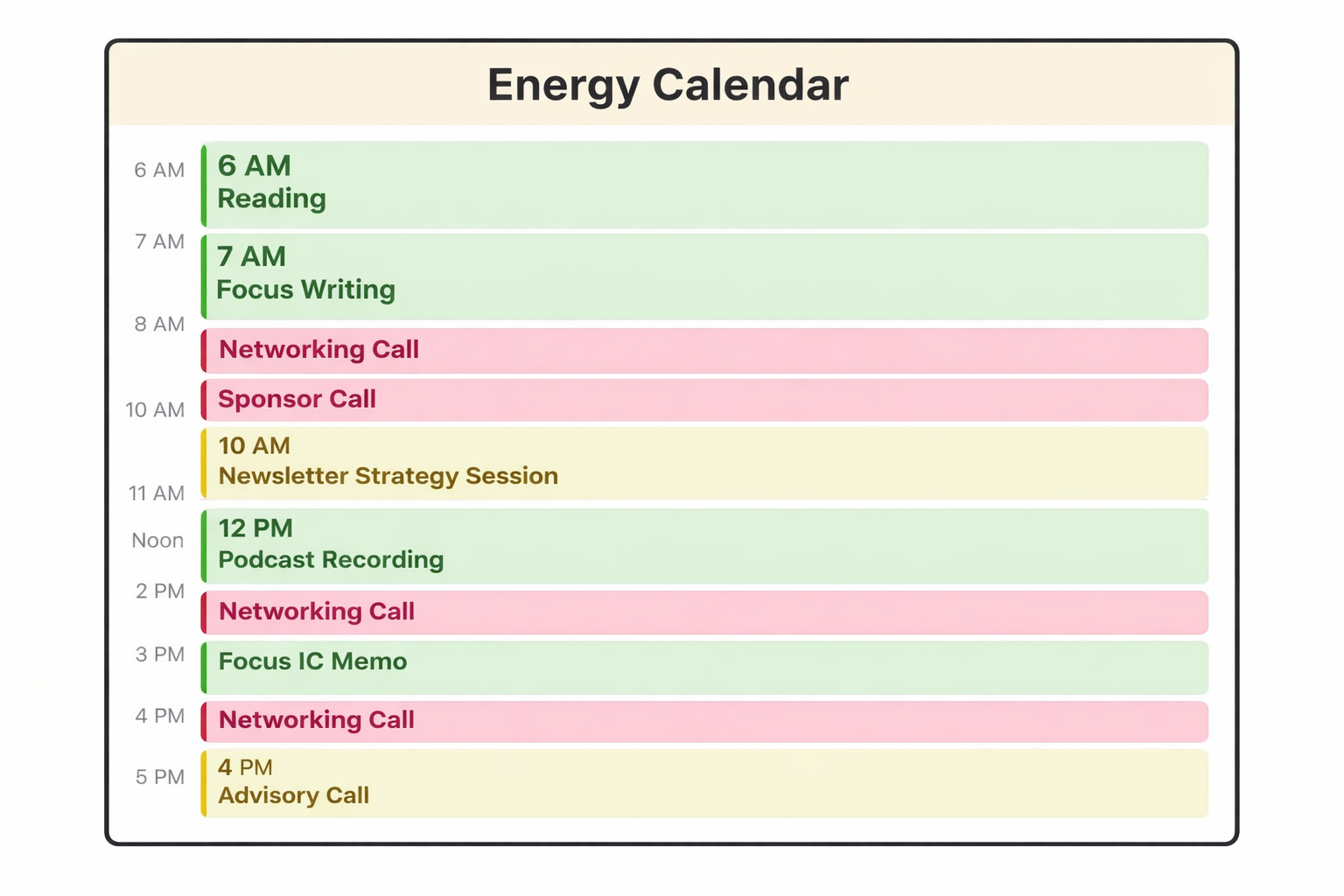
I want to share one of the simplest tools I’ve used to help clients train smarter: the Energy Calendar, originally popularized by creator Sahil Bloom.
The premise is straightforward: most people track time, but very few track energy. And yet energy is what determines how well you show up, in training, in recovery, and in life.
Here’s how it works:
At the end of each day, look back at your workouts, meals, meetings, or recovery routines and label them:
🟢 Green = Energy-gaining (left you feeling stronger, clearer, more focused)
🟡 Yellow = Neutral (you got through it, but no real shift either way)
🔴 Red = Energy-draining (left you depleted, unfocused, or needing extra recovery)
Do this for 5–7 days. Then zoom out and spot the patterns.
For example:
• Are your afternoon workouts consistently 🟢, while early-morning lifts are 🔴?
• Does one type of training leave you wiped for the day, while certain ones gives you clarity?
• Are you underestimating how much emotional stress (e.g. difficult meetings, poor sleep) is impacting your performance?
You’ll quickly see trends emerge. From there, it’s all about rebalancing:
• Double down on greens. Time your hardest lifts or high-focus sessions to match your energy peaks. For many, that’s mid to late afternoon, when core body temperature and neuromuscular coordination are naturally higher.
• Reposition or reduce reds. Don’t scrap hard sessions entirely, but give yourself more runway to recover. That might mean pushing an interval day later in the week or skipping a “just-because” extra session.
• Program recovery like a pro. Make sure greens aren’t only workouts. Sleep, food quality, hydration, and mental resets (walks, massages, meditation, etc) count too.
The biggest benefit? You stop guessing. You stop blindly following cookie-cutter plans and start programming based on your energy rhythms.
This is how elite performers train, not just by effort, but by awareness.
If you want to test this for yourself, grab a physical calendar or Google Sheet and color-code the last week. Then ask:
• What gave me energy?
• What stole it?
• What needs to shift so I can train harder and recover better?
I’ve done this myself, and it’s changed how I structure my own blocks of training, coaching, and deep work. Try it. Your energy is too valuable to waste. |
| | | |
| | | |
| | | |
| | |
| Real-World Spotlight: Dr. Matthew Walker on Sleep
Yes, we all know sleep is important. But most people still treat it like a suggestion instead of a strategy. Dr. Matthew Walker, neuroscientist and author of Why We Sleep, makes it clear: if you’re not sleeping well, you’re not managing energy, you’re borrowing it on credit.
I (Michael) read his book last year, and it completely reframed how I think about recovery, performance, and the role of sleep in sustaining long-term output.
Walker’s research shows that sleep isn’t just recovery, it’s energy regeneration at the deepest level. Without it, your physical stamina, mental clarity, and emotional regulation all suffer. In short: poor sleep = poor energy = poor performance.
Key takeaways from his work:
• Sleep is your primary energy reset – It restores glycogen in the brain, balances hormones, repairs muscle tissue, and clears metabolic waste.
• Deprivation destroys efficiency – After 17 hours awake, you’re cognitively impaired to the same degree as a 0.05% blood-alcohol level.
• Training and sleep work together – Athletes who sleep more get stronger, recover faster, and improve reaction times.
• Circadian alignment matters – Respecting your biological rhythm (whether you’re a morning lark or night owl) boosts consistent energy output.
• Environmental cues are key – Darkness, cool temperatures, and a tech-free wind-down routine set your system up for real recovery.
Walker calls sleep “the most effective thing we can do to reset our brain and body health each day.” In terms of energy management, it’s not optional, it’s foundational.
For a deeper dive, here’s the book:
📘 Why We Sleep by Matthew Walker → https://www.amazon.com/dp/1501144316 |
| | | |
| | | |
| | | |
| | |
| 📝 Interactive Journal: Energy Awareness in Action
This week’s journaling practice is all about learning how your energy actually works, not how you think it works. The goal is to surface hidden patterns, so you can make smarter decisions about how you train, work, and recover.
Step 1: Track Your Energy
For the next 5–7 days, at three points during the day (morning, midday, evening), rate your energy on a scale of 1–10. Then jot down what you were doing and how you felt. Keep it simple:
• Time of day
• Energy level (1–10)
• What you were doing
• Was it 🟢 green (energizing), 🟡 yellow (neutral), or 🔴 red (draining)?
• Any quick notes on sleep, food, stress, training, or mood
Step 2: Zoom Out at Week’s End
Look back and find patterns:
- When do you typically feel best?
- What habits consistently drain you?
- Do certain people, tasks, or workouts shift your energy more than you thought?
- Are you stacking reds without enough greens to recover?
Step 3: Design a Small Shift
Pick one change to make based on your insights. Maybe that’s:
• Moving high-effort work to your afternoon energy peak
• Swapping a late-night scroll for a wind-down walk
• Replacing a draining group workout with a solo session that feels better
• Eating a real breakfast instead of skipping it
Step 4: Reflect with Perspective
At the end of the week, answer:
• Where did my energy rise most easily?
• Where did I waste it or ignore its signals?
• What’s one adjustment I’ll test next week?
For more structured prompts, daily reflection space, and guided exercises to build confidence and consistency, explore the journal that pairs with our resilience work.
👉 Awaken the Tiger and Phoenix Self-Esteem Journal
https://www.amazon.com/Awaken-Tiger-Phoenix-build-Esteem/dp/B0DBRWTGS9 |
| | | |
| | | |
| | |
| Final Thoughts: Energy and the Five Pillars
Energy is the common thread between effort and outcome. When it’s high, things feel possible. When it’s low, even basic tasks feel like uphill battles. That’s why managing your energy, not just your schedule, is one of the most strategic moves you can make for sustainable performance.
Here’s how energy management connects directly to the Tiger Resilience framework:
Purpose
When your energy is drained, even meaningful goals lose their pull. Protecting and renewing energy helps you stay connected to your “why” and avoid burnout. Purpose thrives when you have the capacity to pursue it.
Planning
A plan that ignores energy is just a to-do list. Smart planning accounts for energy peaks, recovery windows, and mental bandwidth. That’s how you turn consistency into momentum.
Practice
Daily habits depend on energy. When you align training, nutrition, work, or mindset routines with your body’s rhythms, practice sticks. Energy is what turns effort into repeatable progress.
Perseverance
Grit isn’t just about pushing through. It’s about knowing when to push and when to recharge. Managing energy makes perseverance sustainable, so you don’t break down halfway through the journey.
Providence
Being at the right place at the right time doesn’t help much if you’re too exhausted to seize the opportunity. Energy fuels readiness. When you manage it well, you’re more alert, more present, and better positioned to act when it matters.
In the end, managing energy is about making space for your best self to show up more often. It’s not about doing less. It’s about doing what matters, with more clarity and strength.
Stay Resilient,
Tiger Resilience
📚 References
Andrews, J., Ali, A., & Preece, S. J. (2018). The effect of time of day on the performance of high-intensity training in trained athletes: A systematic review. Chronobiology International, 35(4), 445–457. https://doi.org/10.1080/07420528.2017.1417312
Blanchfield, A. W., Hardy, J., De Morree, H. M., Staiano, W., & Marcora, S. M. (2014). Talking yourself out of exhaustion: The effects of self-talk on endurance performance. Medicine and Science in Sports and Exercise, 46(5), 998–1007. https://doi.org/10.1249/MSS.0000000000000184
Cuddy, A. J. C., Wilmuth, C. A., Yap, A. J., & Carney, D. R. (2015). Preparatory power posing affects nonverbal presence and job interview performance. Journal of Applied Psychology, 100(4), 1286–1295. https://doi.org/10.1037/a0038543
Dallman, M. F. (2010). Stress-induced obesity and the emotional nervous system. Trends in Endocrinology & Metabolism, 21(3), 159–165. https://doi.org/10.1016/j.tem.2009.10.004
Damasio, A. (1994). Descartes’ error: Emotion, reason, and the human brain. Putnam.
Hirshkowitz, M., Whiton, K., Albert, S. M., et al. (2015). National Sleep Foundation’s sleep time duration recommendations: Methodology and results summary. Sleep Health, 1(1), 40–43. https://doi.org/10.1016/j.sleh.2014.12.010
Kleitman, N. (1963). Sleep and wakefulness (Rev. ed.). University of Chicago Press. [Origin of ultradian rhythm theory]
Lo, J. C., Ong, J. L., Leong, R. L., Gooley, J. J., & Chee, M. W. (2016). Cognitive performance, sleepiness, and mood in partially sleep-deprived adolescents: The need for sleep study. Sleep, 39(3), 687–698. https://doi.org/10.5665/sleep.5552
McEwen, B. S. (2004). Protection and damage from acute and chronic stress: Allostasis and allostatic overload and relevance to the pathophysiology of psychiatric disorders. Annals of the New York Academy of Sciences, 1032, 1–7. https://doi.org/10.1196/annals.1314.001
Michaud, T. M., et al. (2020). Decision fatigue: A review of the phenomenon in physicians. Journal of the American Medical Association (JAMA). https://jamanetwork.com/
Patel, A. I., Hamad, R., & Leung, C. W. (2020). Diet quality and productivity: A review of the evidence. Annual Review of Public Health, 41, 139–158. https://doi.org/10.1146/annurev-publhealth-040119-094404
Porges, S. W. (2007). The polyvagal perspective. Biological Psychology, 74(2), 116–143. https://doi.org/10.1016/j.biopsycho.2006.06.009
Schwartz, T., & Loehr, J. (2003). The power of full engagement: Managing energy, not time, is the key to high performance and personal renewal. Free Press.
Schwartz, T., & McCarthy, C. (2007). Manage your energy, not your time. Harvard Business Review. https://hbr.org/2007/10/manage-your-energy-not-your-time
Schoenfeld, B. J., Contreras, B., Vigotsky, A. D., & Peterson, M. D. (2016). Differential effects of training duration and timing on performance and muscle adaptations. Journal of Strength and Conditioning Research, 30(6), 1727–1736. https://doi.org/10.1519/JSC.0000000000001288
Thayer, J. F., Åhs, F., Fredrikson, M., Sollers, J. J., & Wager, T. D. (2012). A meta-analysis of heart rate variability and neuroimaging studies: Implications for heart rate variability as a marker of stress and health. Neuroscience & Biobehavioral Reviews, 36(2), 747–756. https://doi.org/10.1016/j.neubiorev.2011.11.009
Walker, M. (2017). Why we sleep: Unlocking the power of sleep and dreams. Scribner. https://www.amazon.com/Why-We-Sleep-Unlocking-Dreams/dp/1501144316
Watson, N. F., Martin, J. L., Wise, M. S., Carden, K. A., & Curhan, G. C. (2017). Delaying middle school and high school start times is a key factor in reducing adolescent sleep deprivation. Journal of Clinical Sleep Medicine, 13(4), 623–625. https://doi.org/10.5664/jcsm.6558
World Health Organization. (2020). Guidelines on physical activity and sedentary behaviour. https://www.who.int/publications/i/item/9789240015128
Sahil Bloom. (2023). The Energy Calendar. Twitter/X Thread. https://twitter.com/SahilBloom/status/1654947744732368896 |
| | | |
|